Categories
Communiqués

WI: Report Back 3

by Dan S. Wang

This third report from Madison is difficult to write. Since at least the middle of last week there are too many lines of development for one person to follow, much less explain. In that sense, the Wisconsin uprising has truly become a broad movement, complete with sub-fronts, fissures, and rumors swirling daily. Ten days ago I still had the security of knowing that I had a privileged view of the struggle by virtue of living here. Now, I get the feeling that I’m only seeing the close-up action, while larger forces with national reach, perhaps imperceptible to us inside the city limits, are somehow shaping the contest.

This feeling of disconnect, of the local movement having lost its monopoly on the narrative, was confirmed when I started receiving email blasts last week from MoveOn, Democracy for America, TrueMajority, and other national progressive groups. After about the third one (and there have been countless since) I cringed to see the creativity, humor, and outrage of a citizen and worker-driven, organically developing movement that has no central leadership, and variable demands, be reduced to a branded online petition and donation button. I’ll take the sectarian newspaper hawkers over the dumbness of a professionally marketed email cause (of the week, or until donations crest) any day. At least the sectarian leftists entertain with their inadvertant goofiness. 

Let’s talk about three fronts to this battle: the space of the Capitol, the April 5 election, and the possibility of a strike. Each one is a complicated tale in its own right.

Up until about last Sunday night, Feb 27, the Capitol building could be accurately described as occupied. Up until late this past Thursday there were still protestors inside. For their last four days they dwindled in number and were basically cut off from the outside. The attrition—once a person exited, they were not allowed back in—guaranteed that the authorities would retake the Capitol sooner or later.

The Capitol police had been boxing demonstrators out of various corridors and corners of the building all week long. The occupied space shrunk continuously through the simple tactic of clearing people out of a section “for cleaning” and then marking that section off with police tape and posting police to guard it. The order to vacate the building in whole was finally delivered on Sunday, but with several hundred demonstrators inside, the police chose to let people stay but locked newcomers out. And so the attrition began. Looking back, it was a very smart non-confrontational move on the part of the Capitol police.

This Wisconsin constitution specifies that the Capitol is to remain open to the public during all daytime hours. Scott Walker flouted this constitutional guarantee, thereby inviting a lawsuit. A Dane County judge quickly granted the demonstrators a temporary restraining order on Monday, preventing the governor from locking out the public. But he flouted that, too, and kept only one door unlocked and guarded, and set rules for who could come in—some vague requirement that it be “on official business.” The situation became so ridiculous that the Dane County sheriff, Jim Mahoney, took the extraordinary step of relieving his deputies of having to guard the entrances. Walker doesn’t control the sheriff, and Mahoney let him know it by quipping that the sheriff’s deputies “are not palace guards.” Thus continued the sub-plot of Scott Walker antagonizing even law enforcement. (Word from unnamed sources is, the Madison police—one of the best educated forces in the country—are resentful. He’s transferred into Madison a bunch of outstate cops to help, but their loyalty is questionable, too. Only the Capitol police are under his strict control.)

The Teaching Assistants Association ran the occupation—coordinated cleaning, managed the food, kept in contact with the police, etc—and they had the option on Sunday to end the occupation on their terms, in consultation with the police. They chose not to, and the lockout is what happened; after a few days of legal wrangling, the building was opened to the public again, but with shifting and possibly illegal conditions placed by the governor. No matter. Even with this setback and miscalculation, the occupation was a success. In America there have been only a handful of occupations of state capitol buildings historically, and all the rest were only for a day or part of day. The occupation in Madison went on day and night for thirteen days. Already it is widely acknowledged as an historic event. The longer term ramifications are unsettled, but clearly there will be some. As far as the governor bringing in the heavies goes, here again, as with this whole sorry tale to begin with, he overreached. The video of a Democrat lawmaker getting thrown to the ground while trying to enter the building has further hurt the standing of the governor. 

Equally important has been the nature of the occupation, what it proved to the demonstrators, and what the space became. During the day the rotunda was a cauldron of shared anger, the drumming and unison shouting so loud it made your ears ring, and kept the lawmakers hidden deep in their chambers and offices on edge all day long. By the second week, the occupied areas would turn into a social forum in the late evenings and nighttime, with people coming to read the hundreds of signs, to talk politics with strangers, to eat free food, and to perform music or speechify from the open mike center. It was quite a sight, and for anybody who entered during those days, one’s sense of possibility could not help but be enlarged—this was a co-op, a commune, a punk house (where everybody cleaned up after themselves, imagine that), a labor temple, a free speech zone…in the freakin’ state Capitol building! When does that ever happen?! This will not be erased from memory anytime soon. Also worth reiterating here is the way the occupation started. That first Tuesday night/early Wed morning, Feb 15-16, when debate was cut off by the Republicans, those waiting to testify against Walker’s bill were so many and so livid with anger that the police couldn’t do anything. The cops were too scared. Those who weren’t scared were sympathetic.

Here is very good take on the occupation, how it evolved, what it served, what it meant. Sorry, you have to read it on Facebook.

Next: The April 5th election. The reality is, should Scott Walker ram through his bill—and all indications are that he still believes that he can—many of the provisions will be decided in the courts. The Wisconsin Supreme Court now has a 4-3 conservative majority, but a sitting conservative judge is up for election on April 5, facing a liberal challenger, an environmental law attorney from lefty Madison. (In Wisconsin judges are an elected position. As in all other parts of American political life, what used to be a rather sedate, non-partisan affair has in recent years become yet another polarized fight zone.) This election will be treated as a referendum on the Walker agenda. One question is, then, how will the movement make the transition from street demonstrations to taking a side in an electoral campaign? Are there enough people with enough energy to keep Scott Walker embattled with large demonstrations at the Capitol for the next four weeks while also ramping up work on what is normally a low-key, low turnout, spring election? As well, there are now recall campaigns underway, targeting the eight eligible Republican state senators, ie who have been in office for at least a year already. The recall process is by design extremely demanding, and no matter how energized an electorate, requires a great deal of effort for even a chance of success. The movement only needs to recall and replace three senators to gain control of the Wisconsin Senate, but even this will require the dedicated attention of many activists, not to mention money, legal counsel, media work, etc.

In sum, since my last report, battles on the terrain of conventional electoral politics have emerged as another true front of the struggle. Here, too, as with the contest over control of the Capitol, there is a politics of space in play, but at the comparatively neglected scale of the state senate districts, typically encompassing an average population of 160k, some more and some less, and a ground area of about two or more counties. One by-product of all this mess is, thousands more state residents will learn for the first time what the size and shape of their senate district is, and, moreover, what it means to act politically at that scale of space. For nearly a generation now, the US left has permitted the right to act at this and other mid-level scales of governance with hardly any challenge. This newly sparked engagement cannot be a bad thing, especially in the long term—unless it drains movement attention and substantial bodies from the still-important demonstration spectacles on the Capitol square. To spell out the dilemma: the fourteen awol Democrat senators are the only thing standing between Scott Walker and his agenda being legally realized, but they can only stay away for as long as there are large daily and occasionally massive demonstrations of support, and realistically, can only stay away until the April 5 election. So the demonstrations must not dilute the campaign messaging, and ideally, need to echo it, but at the same time not be reduced to it. To lose the April 5th election and to fail on the most achieveable recall efforts would, unquestionably, be major defeats.

Finally, there is the spectre of a strike. The truism of labor’s ulimate power being that of withholding its work activity, which in the US context sounded practically meaningless only a month ago, rings with revitalized freshness, given the threats of force and firings being leveled by this governor. But how and when? Who and where? Teachers? Students? Those who are legally granted the right strike, or those who instantly run the risk of being fired? What is the strike supposed to communicate? How does it get organized, and what kinds of practicalities would be involved? Would it be a symbolic one-day strike or a true shut-down of business as usual? The South Central Federation Labor has already endorsed a general strike, so the language is getting out there and these questions coming into play.

Already there are two points of reference, generated by the movement itself. One, during the first week we saw the Madison Public School teachers essentially call a strike without using strike language, shutting down the schools for three days through a massive sick-out. It was a bet that paid off, but only because the message was not primarily about leaving work to protest the budget cuts and attacks on unions; rather, the message was one of love, as in, the teachers love their jobs, schools, and students so much, that they are walking out, and the students love their teachers so much, that they are joining them, and the parents love their children’s teachers so much, that they are supporting them. The message of love is what a proper and possibly general strike must convey—the conservatives have found it impossible to argue against it, and even have professed the same love, to the jeers of the public. And then two, to return to the occupied Capitol, there now exists an actual model of a self-organized society, an example of something that worked. Over the two weeks of occupation, food stations, childcare, clean-up crews, first aid and internal communication structures inside the Capitol were set up as needed. In contemporary America the term mutual aid is tossed around by radicals as a vague, dreamy concept, or else made real through slowly growing limited projects around a given focus of cooperative energy. Here mutual aid became real in a way that was entirely outside of our American experience, as a process of change, spontaneous giving, and practical adjustment, focused on meeting immediate and concrete needs that arose in new situations daily. What happened at the Capitol shows us that the many kinds of support that a strike beyond three days would require *will* materialize, even if in the end it’s neither perfect nor sustainable. Strikers will not be left high and dry by their fellow workers, their neighbors, their friends.

The who and when of a strike is the biggest question. If Scott Walker follows through on his threatened firings of state workers, 1500 or a thousand at a time, for no other reason than to pressure the absent Dem senators into returning from out of state for a vote, then the mood for striking will go up. I suspect the teachers’ union would be the first to declare; if and how other unions respond will be most important. If AFSCME turns scared in that moment and publicly dissociates itself from strike tactics, the battle may be lost. If they merely hold their cards, refusing to say one way or other, then I think the momentum towards a strike will build, especially if there are massive student strikes, too. If any other union joins the teachers with a sympathy strike that goes beyond a short symbolic gesture, then the general strike may indeed be on, especially if the governor reacts with aggression.

Other points:

1)   As expected, national media coverage has been atrocious. While utterly oblivious in some significant and surprising respects, Scott Walker has proven himself a skillful handler of journalists, and nearly impossible to shake from the script. While he’s managed to skew the national media discussion toward the smokescreen of budgetary matters by repeating the same script with each and every appearance, the non-corporate media (just one example: rotundaville) has been disseminated so widely, and the numerous media lies of Walker are so quickly debunked, that Walker’s single and well-practiced strategy is not enough to drive the narrative.

2)   After Walker unveiled his bi-annual state budget last Tuesday, new outrage arose from heretofore quiescent parts of the state—particularly in the rural areas and in the urban core. The massive cuts to schools and healthcare he had planned for the budget were based on the first bill passing, which would have freed up county and town governments to do away with their public sector union employee contracts as a way to make up the shortfall in state funding. The governor put off announcing his budget for two weeks, hoping the demonstrations over the “budget repair bill” would die down. They haven’t, and now he’s had to show the whole state exactly what he has in mind for them, thereby digging himself a deeper hole, politically. After three weeks, we can say definitively: Scott Walker has been the greatest gift to the American left since Richard Nixon, and maybe even since Bull Connor. 3)   The rural and urban expressions of discontent arrive in Madison this coming weekend. A farmer-organized convoy of tractors is scheduled to demonstrate on the square on the same day that a march of high school students from Milwaukee arrives. These actions come just in time. Even though the past three Saturday demonstrations have turned out massive numbers of protestors, the energy that comes out of a new and unexpected movement is dissipating. The protracted struggle has begun and the anti-Walker constituencies must adjust to the reality of political work without the advantage of novelty. As with the convoy and march, coming up with new storylines is a necessity if we are to maintain visibility as proof of commitment.

4)   As the struggle has take a turn for the local, with thousands of activists diving into the minutiae of recall campaigns, dealing with the legalities concerning the fourteen absent Dem senators, and countless other details of hard-slog politicking, the international dimensions are fading from front-line consciousness. As it happens, the main battle from the other side of the globe is no longer a peaceful occupation of Tahrir Square, but a shooting civil war in Libya, complete with hundreds of gruesome deaths, displaced peoples, and a paralysis in international response. Thus, the comparisons no longer suit. But even without convenient parallels that insist on connection, I hope it is not lost to people both inside and outside of Wisconsin, inside and outside of the US—what’s happening in Wisconsin matters to the world, for the following reason. The election last November of Scott Walker along with Ron Johnson’s defeat of Russ Feingold for a Wisconsin US Senate seat were taken by the national GOP as a model and pathway to their future power, so much so that Wisconsin GOP head Reince Priebus was elected to lead the Republican National Committee shortly after, and then Janesville, Wisc., congressman Paul Ryan was granted the slot to respond to Obama’s State of the Union address. Walker is seen as the operations guy, Priebus the strategist, and Ryan the policy brains—the rising star triumvirate of the GOP. Because of their national prominence, if they manage to win the day in Wisconsin, the rest of the world will feel no doubt feel the effects. If we win, we will have struck a blow against all three. How to reinstall the internationalism of the movement’s first week under these changed conditions is the challenge.3)   The rural and urban expressions of discontent arrive in Madison this coming weekend. A farmer-organized convoy of tractors is scheduled to demonstrate on the square on the same day that a march of high school students from Milwaukee arrives. These actions come just in time. Even though the past three Saturday demonstrations have turned out massive numbers of protestors, the energy that comes out of a new and unexpected movement is dissipating. The protracted struggle has begun and the anti-Walker constituencies must adjust to the reality of political work without the advantage of novelty. As with the convoy and march, coming up with new storylines is a necessity if we are to maintain visibility as proof of commitment.

4)   As the struggle has take a turn for the local, with thousands of activists diving into the minutiae of recall campaigns, dealing with the legalities concerning the fourteen absent Dem senators, and countless other details of hard-slog politicking, the international dimensions are fading from front-line consciousness. As it happens, the main battle from the other side of the globe is no longer a peaceful occupation of Tahrir Square, but a shooting civil war in Libya, complete with hundreds of gruesome deaths, displaced peoples, and a paralysis in international response. Thus, the comparisons no longer suit. But even without convenient parallels that insist on connection, I hope it is not lost to people both inside and outside of Wisconsin, inside and outside of the US—what’s happening in Wisconsin matters to the world, for the following reason. The election last November of Scott Walker along with Ron Johnson’s defeat of Russ Feingold for a Wisconsin US Senate seat were taken by the national GOP as a model and pathway to their future power, so much so that Wisconsin GOP head Reince Priebus was elected to lead the Republican National Committee shortly after, and then Janesville, Wisc., congressman Paul Ryan was granted the slot to respond to Obama’s State of the Union address. Walker is seen as the operations guy, Priebus the strategist, and Ryan the policy brains—the rising star triumvirate of the GOP. Because of their national prominence, if they manage to win the day in Wisconsin, the rest of the world will feel no doubt feel the effects. If we win, we will have struck a blow against all three. How to reinstall the internationalism of the movement’s first week under these changed conditions is the challenge.

Categories
Features

Ask About An Autonomous University: 5 Exam Questions For Life

When I talk about the current crisis with people who use universities, I like to find out what they want, so I ask questions. Since I can’t imagine a level of funding that would make the education industry tolerable under capitalism, I ask how we can imagine simultaneous occupation of and withdrawal from school. Common university ideology makes us feel that our work is a labor of love, yet resentment and fear fill our days. Exhaustion grips us to such an extent that we have no choice but to withdraw, but rather than fleeing into our families, the latest 3D entertainment or the hippest new bar, perhaps we could collectively seek refuge in an autonomous school we might tolerably call our own. Perhaps such a university could somehow open a future.

I ask soft questions at first, leaving more difficult issues for others to ask in discussion. Starting with our immediate desires for working and learning allows a group to wonder about the kind of world an autonomous university needs and might help to produce. Almost always, someone, usually an undergraduate, wants to know how militancy can become part of education and how a school might become a dynamic seed of revolutionary change. Someone else, usually a faculty or staff member, usually asks what sorts of change would be needed so that a parent who needs time wouldn’t have to worry about child care. In order to answer that question, the group has to imagine radical restructuring of what it means to live and work at a school.

All of these questions ask how we can imagine a university independent of the state and designed by our desires: a communized school. Most people think this crazy at first. Then they start to fantasize. The gap between what they really want and what they currently have to do to participate in universities starts to educate us about the challenges we face. More importantly, our fantasies could be realized if we stopped attending to our masters. Our bosses say that outside of science and business education, the university doesn’t produce anything worth paying for. I choose to take them at their word and suggest we let them try to live without us.


1) Why are we interested in continuing to work in universities as they are?

If we remain at our jobs for our paychecks, let’s admit it. Compensation for students, staff and faculty dwindles every year while our workload increases. Recently, group of department heads at my institution proposed unpaid furloughs and increased teaching loads to help solve the schools financial woes. Such an offer assumes that we love teaching and learning. Surely we do, but we can also imagine ways to act on that love other than by rendering ourselves daily to an institution that betrays the very premises of education and makes every creative act painfully frustrating. We must sort aspects of our current situation that we value from the conditions that revolt us.


2) How can temporary autonomous schools be made more stable without becoming institutions?

We can think of many examples of temporary autonomous zones within and around universities: reading groups, support forums, certain kinds of exhibitions, self-funded film series, informal athletic communities etc., etc. Historically, in times of extreme hardship such as the Russian revolution, classes taught by figures like Lev Kuleshov became autonomous zones because there weren’t any institutions to receive support from. The glories of 1920s Soviet cinema emerged from Kuleshov’s winter classes in a roofless room without a projector, camera or film stock. One might also think of the Bahktin Circle from which works emerged as powerful as Toward a Philosophy of the Act, Marxism And The Philosophy Of Language, and The Formal Method in Literary Scholarship. After the revolutionary the period, what had been autonomous became institutional once again. How can we learn and live without reifying ourselves and reproducing our current hardships within yet another system?


3) What role does accreditation play in what we do?

People often tell us that even if we could occupy the buildings of a university and build our own curriculum there, we would lack legitimacy. Accreditation mostly serves as a sign that a school can legitimately create a hierarchy of job candidates for employers. As labor at all levels become increasingly precarious, a degree and a high GPA become increasingly expensive but illegitimate commodities. If jobs don’t exist, a degree can’t help us get them. The idea that education aims at employment lacks any legitimacy in the first place. Many faculty members got into the business partly out of a profound discomfort with the lived experience of capitalism. We all must eat and care for our children. Can we imagine a way to do so and have the world respect us without serving as a motor of social reproduction in a system that makes so many of us want to flee?


4) Would autonomous universities evaluate learning?

An autonomous university might not have grades. Perhaps the faculty would be able to acknowledge that they learn as much as the students do. Perhaps the students would be able to be open and honest about what they get out of their experiences at the school. Like accreditation, grades serve to differentiate the labor force while rendering future workers servile. To add insult to injury, of all the onerous tasks current universities demand, those who do it complain about grading the most. We can think of more productive forms of feedback.


5) How can the exploitative character of self-administration be corrected?

Aside from the utterly unnecessary managers, underpaid women do most university secretarial work. In the late 1980s and the 1990s universities used personal computers to shift some of the administrative burden onto faculty members without compensating them for the work. Teachers became more exploited and many secretaries became unemployed. Today’s institutions oblige faculty not just to print out their own syllabi and do their own accounting, they also require teachers to use poorly designed web-based learning software for every class and help build the departmental websites, creating more work while salaries get reduced. Perhaps in a university we could call our own, administration would take a different form.


Categories
Communiqués

LSE Students Occupy Against University’s Ties To Libyan Regime

At 7PM on February 22nd, Students at the LSE began an occupation of the Senior Common Room in the Old Building (Houghton St.) against the LSE’s regarding their association with the Libyan regime. 

In light of recent events the LSE administration announced that they would no longer be accepting the money from the Gaddafi family. They have already accepted £300,000 and were scheduled to receive and additional £1.2. 

Students are demanding:

a) A public statement by the LSE administration denouncing the recent gross violations of human rights by the Gaddafi regime and Saif Gaddafi’s violent threats against the protesters in Libya

b) A formal commitment by the LSE refraining from cooperating with the Libyan regime and any other dictatorial regimes that are known to be implicated in gross violations of human rights.

c) Rejecting the rest of the yearly installments that are being received from the £1.5 Million donation of the Gaddafi International Charity and Development Foundation (GICDF) and work towards creating a scholarship fund for underprivileged Libyan students using the £300k that LSE has already accepted and not spent yet.

d) Revoking Saif Gaddafi’s LSE alumni status, as his public statement on Sunday 20th of February and the various reports issued by International Human Rights Organisations clearly demonstrate that he is implicated in the killing of innocent civilians as well as other human rights violations. His association with the LSE community and particularly its student body is a disgrace that is not tolerated by the LSE staff, students and alumni.
e) Publicly committing that no grants from officials of such oppressive regimes will be accepted in the future by establishing a set of standards and a process of democratic decision-making with student representation that determines whether or not the School should accept money coming from controversial donors.
Failing to do these would not only betray the LSE’s ethical values, it would also tarnish the School’s reputation in a region whose people are currently fighting to reclaim their freedom from corrupt dictatorships–and are winning the fight so far.
Following the publication of these demands LSE students will occupy a space on LSE campus.

LSE Occupation

Categories
Communiqués

Latecomers crash the party

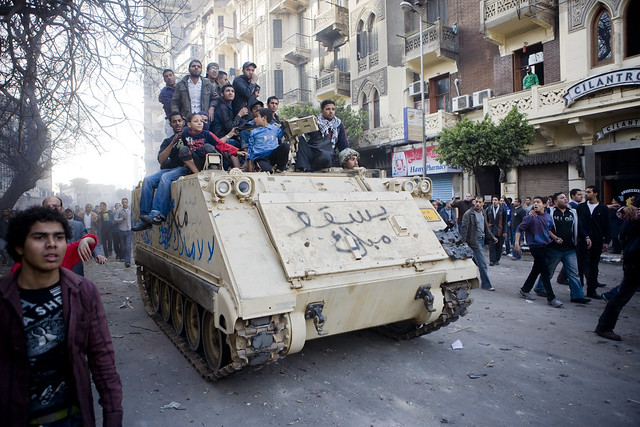
The readers of this blog, what few may remain, have surely longed for an update on events in Occupied Cairo. Because, yes, it’s still quite occupied. Even from the beginnings of celebrations of Mubarak’s resignation, groups were chanting “this isn’t an end, this is just the beginning.” The myriad labor actions in the past week give this chant credence, if nothing else. We now find ourselves in the midst of a strange occupation by the Egyptian military and military police, and the demands of those who went out in the streets are now caught between the military’s paternalistic calls to go home and keep quiet and the murmuring of others who seem to just want things to go “back to normal.”

A lot has been written on the Egyptian military recently, and as far as this post goes it should suffice to say that they’re not to be trusted as benevolent protectors. The other danger though, is more peculiar, not marked by any uniform and not even as confrontational or identifiable as the Baltagiya that we saw roaming the streets with weapons and posters of Mubarak a couple weeks ago.

It seems now that you’ll inevitably find at least one troublemaker milling about Tahrir and any given Labor strikes/demonstrations, all basically the same type. These troublemakers generally seem to be on last week’s news cycle courtesy of State TV, and from their words and accusations you can tell they’ve not spent a day in Tahrir. In the middle of a group of people all calling for the same thing (better wages, a change in government structure, etc.) you’ll find one of these types pick on someone in the crowd–sometimes a journalist, a foreigner, but not necessarily–and start making wild accusations about foreign agents, journalism ruining Egypt’s reputation abroad, or whatever. It’s as if they were paid provocateurs how effectively they distract and rile up a crowd, but the fear is that these are autonomous cretins who sat out the past three weeks and now feel like it’s time for them to get their say in. I’ve had several friends (all of them Egyptians) targeted in these sorts of situations, and while they’re generally resolved without violence they’re an absolutely disgusting spectacle, preventing participation by some and the transmission of the exact sorts of images that have given the Egyptian people the admiration of the world in past weeks.

It’s uncertain how these types are best dealt with, one suggestion has been just to fight fire with fire and accuse them of being National Security or Intelligence (they are, after all, doing the same work gratis). Solidarity and shared understanding amongst those protesting and demonstrating will also be a primary mechanism of fighting this sickness, preventing it from getting a foothold within the crowds. While these may work to diffuse an immediate confrontation, the bigger question still points back to the culpability of the Egyptian state media in propagating these lies and suspicions, and their failure–even after their apparent change of heart–to actively rehabilitate all the propaganda they put out. State media still needs to either be shut up, taken over by revolutionary forces or effectively countered by distribution of alternative information, etc. The latter is currently being attempted by many fronts with some efficacy (this could be seen when protestors outside the state TV building shouted “Where’s Al Jazeera? The Liars are right there!”) but stronger remedies may still be needed.

The second group, called only half-jokingly “the cleanup thugs” or “the chic thugs” are the groups of youth cleaning up downtown and Tahrir. Don’t get me wrong, it’s amazing to see the city sparkle (excepting the dust) but this isn’t just some apolitical adopt-a-midan program. We saw this first as almost all the anti Mubarak and anti-regime graffiti was painted over, washed out or otherwise erased. Also the stones that people had pulled from the pavement to defend the midan were suddenly carted off, where others had plans to make a monument of them. As symptomatic of the rest of their work, these groups basically sought the disappearance of all traces of the revolution, its battles and its calls for liberty and dignity. To so carelessly push aside this recent history because it somehow violates Egyptian middle class propriety (keep quiet, eyes forward) is dispiriting. A revolution was born in the square just as people were dying in it, and it’s not hardly the time to say “yalla let’s get back to cairo traffic.”

Apologies for the scattered quality of these thoughts, gentle readers, but the post-Mubarak scene and reorganization is still a work in progress, making writing a bit confusing.

source: Latecomers crash the party | http://www.occupiedlondon.org/cairo/?p=339

Categories
Communiqués

“We’re Not Leaving Until Mubarak Leaves”

Kara N. Tina


The Battle for Lazoughli Square ??????? ????? ??? ????? ????????

This interview with Egyptian revolutionary socialist journalist Hossam el-Hamalawy was conducted on Saturday, February 5th at 8pm (Egyptian time). Due to time limitations we were only able to address half of the questions we had prepared. Below el-Hamalawy comments on the current decisive moment faced by those on the streets of Egypt, working-class participation and action, and the role of the army amongst other topics.

The situation in Egypt is developing incredibly fast, can you describe what’s happening in the streets right now?

As i am talking to you there are more than 15,000 demonstrators in Tahrir square who are still occupying it. Earlier in the day the army came to evict the protestors by trying to destroy the barricades they set up near the Egyptian Museum and although the leader of the Muslim Brotherhood in the square Dr. Beltagui had ordered and called upon everybody via the microphone to not resist the army, people shouted back at him including the base cadres of the Al-Ikhw?n [Muslim Brotherhood] who were there. People ran and lay in front of the tanks in order to stop them which they managed to do. Later the army sent the commander of the central region, which is basically Cairo and the surrounding areas, along with three generals, to convince the protesters to leave but they shouted back at him saying “We’re not leaving until Mubarak leaves.”

It’s raining in Cairo now, it’s very cold but the protestors are holding out and more from the other provinces, specifically from Suez, have descended on Cairo to join the occupation today. In the meantime the government is continuing with its witch-hunt and demonization campaign against the protestors, blaming them for whatever malaise the country is going through at the moment which is actually the fault of the government and not the protestors.  This follows twelve days of continuous protests starting on the 25th of January. The 25th of January is National Police Day here in Egypt and that’s when the protests actually started. The Egyptian government wanted to basically liberate the Liberation Square, Tahrir Square, from the protestors today. And they started that in the morning but they have failed. It has been announced that tomorrow the government will resume work and they have called on all civil servants to attend to their jobs and to go to their factories. They wanted to smash the occupation of Tahrir today. But as I’m talking to you that occupation continues.

What are some of the hurdles the protest movement is facing, are there divisions emerging while trying to find common ground?

Yesterday the square was completely packed with more than one million protestors and Alexandria witnessed similar protests as well as the other provinces. But there are definitely big problems that the protest movement is now facing. Which way is the way forward? Today it has been announced that Gamal Mubarak and Safwat El-Sherif, who is one of the most hated figures and was the secretary general of the National Democratic Party, will be removed from their positions and one of Gamal Mubarak’s associates, Dr. Hossam Badrawi was to take the secretary general position instead. There was also news that appeared on Al Arabiya, BBC and Al Jazeera  that Hosni Mubarak had resigned as the president of the NDP, but of course not from his post as President. But now there is confusion because these reports have been denied, then confirmed again and then denied, so we are waiting to see.

It is true that virtually all the opposition groups, whether they are the traditional political parties or the youth groups, have taken part in the uprising but the protests still remain spontaneous. Which means on the one hand, the people always surprise you by their militancy from below that exceeds all expectation, but on the other hand, there is always confusion about what is the way forward and what the clear alternative is. This could pose the threat of this revolution being hijacked. At the moment we have many people claiming to represent the downtown occupation and some of them are even engaged in negations with the government. Some groups say they will not negotiate until Mubarak goes, some think that if Mubarak goes we can negotiate with Omar Suleiman [vice president appointed by Mubarak on January 29th, ex-director of the Egyptian General Intelligence Services and the CIA’s go-to-guy on rendition], others say both Mubarak and Omar Suleiman have to go.

Is there momentum towards protestors taking over the means of production and other institutions of Egyptian society?

On the ground, organizing mechanisms are evolving slowly. Protestors have set up security committees to watch the exits and entrances to the square and to defend it from attacks by Mubarak’s thugs. There are makeshift hospitals that have also been erected in the square to treat the injured form the clashes with the thugs.

Discussions continue in circles that the protestors have put together in order to try to reach some unified demands and people take the platform where there is a mic and address the protestors. Whatever resolutions that the people like they cheer and whatever they don’t like they boo. The uprising up until now contained elements from all Egyptian society, whether it is the urban poor, the working class, and even sons and daughters of the Egyptian elite could be seen in the protest. But as the revolution continues, some polarization has started to happen naturally. Between those who are tired, meaning the middle class and the upper middle class who are saying that we should stop now and try to reach some compromise with the government, and those who basically have nothing to loose and who have sacrificed a lot, like the urban poor and the working class.

The intervention of the working class in the movement is also another question mark, because definitely in some of the provinces where mass protests were organized they contained a majority of workers. But we still haven’t seen an independent movement by those workers. Except in very few cases. For example I received a report about a textile mill owned by a company called  Ghazl Meit Ghamr in Daqahliya, which is a province in the Nile Delta. The workers there have kicked out the CEO, they have occupied the factory and are self-managing it. This type of action has also been repeated in a printing house south of Cairo called Dar El-Ta’awon. There as well the workers have kicked out the CEO and are self managing the company. There are two other cases in Suez, where the clashes were the worst with the security forces during the uprising. The death toll is very high in Suez, we don’t actually know the real death toll until now. In two factories there, the Suez Steel Mill and the Suez Fertilizer Factory, workers have declared an open-ended strike until the regime falls. Other than that we have not seen, at least to my knowledge, independent working class action.

The last thing i would like to note is that the so-called popular committees have been springing up in the neighborhoods here in Cairo and in the provinces. This happened following the collapse of our police force and their cowardly withdrawal in front of the people last Friday [January 28th]. The government started whipping up the security paranoia amongst the citizens in addition to sending plainclothes thugs who were affiliated with the security services, just as it happened in Tunisia, to attack public and private property and fire shots in the air. Citizens immediately stepped in and started forming these popular committees to protect their neighborhoods. They have set up checkpoints, they are armed with knives, swords, machetes and sticks and they are inspecting cars that are coming in and out. In some areas, such as the province of Sharqiya, the popular committees are more or less completely running the town, organizing the traffic etc. But in many cases they also work in coordination with the army.

The army has played an important role in the uprising in Egypt, even receiving support from the US. Can you explain the role of the army amidst the protests?

Our army as you probably know is the biggest army in the Arab world. It receives 1.3 billion dollars from the USA every year. The military institution has always been the ruling institution we have in Egypt, even if our President hasn’t put on the military uniform since 1952. Their intervention by descending on to the streets on the night of Friday, the 28th of January, was based upon the order from the chief of the army, who at the end of the day is Hosni Mubarak. When the army first appeared in the streets they were positively welcomed by the people since the police is hated much more than the army here in Egypt. One reason is that the army does not have much contact with the civilians on a daily basis, unlike the police of course. Since people were sick of the police and paranoid of the security situation they initially welcomed the army to the neighborhoods and also to the entrances and exits of Tahrir Square. However we all know that, number one, the army can’t be trusted and number two, that when you hear Obama and the US administration coming out strongly in favor of a power transition supervised by the Egyptian military you understand what their role is in keeping Egypt stable. Specifically making sure there isn’t a radical regime that could threaten the security of Israel, the security of the Suez Canal and the continuous flow of oil.

The US administration itself has probably made a fool of themselves for the zillionth time owing to their position vis-a-vis the Egyptian revolution. Initially when the protests started HIllary Clinton immediately announced that they were not worried whatsoever and that the Mubarak regime was stable. And Joe Biden went on air and refused to label Mubarak as a dictator. Why? Because Mubarak is a friend of United States and a friend of Israel. This shows you the hypocrisy of the Americans when it comes to their barometer of who is a democrat and who is not. And now when they have finally reached the conclusion that Hosni Mubarak was to be overthrown, they are working day and night in order to secure his removal as smoothly as possible.

Cross-national inspiration was crucial for the wave of uprisings that we are witnessing, has there been the emergence of networks of coordination across Arab nations that are continuing and can pose as a viable alternative to the political landscape we see today?

The domino effect was definitely evident after the uprising in Tunisia. When Ben Ali was overthrown this was very much positively received by Egyptians who could draw parallels between the Tunisian situation and the Egyptian situation. There were also several protests that had already broken out in solidarity with Tunisia. The main slogan chanted in Tahrir Square and around the country is “El-Sha’ab yourid isqat el-Nizam” . This was the same slogan chanted by the Tunisians, “The people want the government to fall.” It is true that in the days leading unto the uprising there was much discussions over the internet and Tunisian activists were transferring some of their experiences when it comes to confronting the police, such as activist kits you should have with you when you are facing the police. But we don’t have any concrete mechanisms for coordination yet. All we get are tweets and emails saying “solidarity”, “we like what you are doing”, “you are a source of inspiration” etc. But i’m afraid that there aren’t any governing or coordinating mechanisms between these two movements yet. How will this develop in the future no one knows but I am personally hoping that this will be the start of something bigger. Because already the domino effect is spreading. You’ve seen Yemen. They have had mass protests against their dictator, who had to come out promising not to run again in elections and not to groom his son for succession. There were similar protests in Jordan and the King was quick to intervene and dissolve the cabinet and bring in a new one. There was already a mini-uprising in Algeria even before Egypt, which was put down brutally by the usual force of the Algerian state. But they have also had to make concessions , they removed the emergency law and they lowered the prices of basic commodities. It is still to early to judge, the uprising here is only 12 days old, in Tunisia it took one month. We’ll see how it goes.

Hossam el-Hamalawy’s photography from the streets:
http://www.flickr.com/photos/elhamalawy/sets/72157625821089247/
http://www.flickr.com/photos/elhamalawy/sets/72157625947671262/

His Blog:
http://www.arabawy.org/blog/

His Twitter:
http://twitter.com/3arabawy

source: “We’re Not Leaving Until Mubarak Leaves” | http://www.occupiedlondon.org/cairo/?p=300