Categories
Communiqués

Open Letter Re: OccupyLA—Solidarity, Critiques, Reinventions

Strong people don’t need strong leaders.
Ella Baker

as many scars
as this after theft the ‘unknown’
becomes ‘the once was’ to form separate dreams after salvage net weights sink pretend it’s all make-believe i need to say pretend that for every name they’ve given us there’s a counter gesture for us to cling to [we] walk leaving traces after light to see

‘after light’
Craig Santos Perez

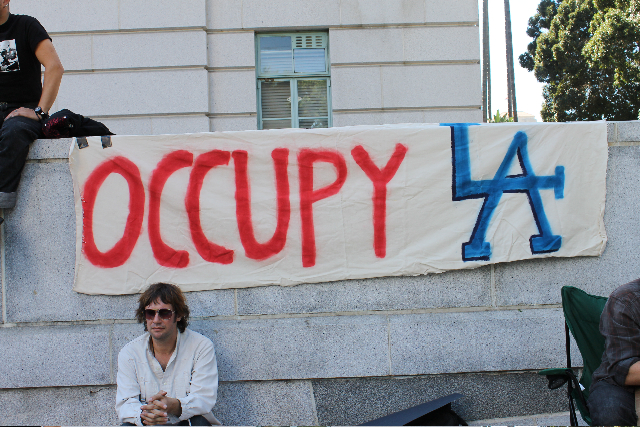
We write to you from the Occupation of City Hall in Los Angeles. First and foremost, in a torrential and tempestuous sea of struggle, we are excited and inspired that people all over the country (and all over the world) are gathering in loose-knit ways to occupy public spaces, to re-think what is possible. It is profoundly significant that this open-ended process has initiated a radically diverse group of participants—including artists like ourselves, who have spent the past week participating in the occupation from the streets around City Hall, from our homes, in our studios and in our classrooms. This is particularly important in Los Angeles—a city that is nothing if not diverse—where public space is under constant threat of erasure and commodification.

We write out of an awareness of the multiple histories and present experiences at play in any “public” space. We are encouraged by occupations of spaces the State would seek to control—and while we use the terms “occupation” and “occupy,” we are also critical of those terms, as deployed, for instance, in the Occupied Territories or in the occupation of Afghanistan (on this tenth anniversary of that particular act of imperialist terror) or as signaling the occupation of indigenous lands that our cities and their infrastructures represent. The reclaiming of words is complicated, messy, and problematic—which is precisely why it is important to speak across languages and to underline the many meanings present in any term or phrase.

We are especially aware of the significance of people coming together to enact alternative forms of organization. People are learning to take care of each other and to construct an infrastructure to maintain and grow the unwieldy space of the occupation—that is, the unwieldy space of the world. We share the concerns of many, however, that strict top-down and hierarchical models of organization are attempting to impose limits and controls on the spirit and the potential of the occupation. We recognize that such hierarchies can be invisible and subtextual; we are aware of the challenges of constructing new modes of relation and self-organization, and of how deeply ingrained structures of power and inequality are—in the marrow of the culture. We share the frustration and resentments expressed by many people of color, women, and queer-identified or genderqueer folks that the space of the occupation sometimes reproduces systems of power that are entrenched in our society, and hence entrenched in our thinking. This is not a peripheral issue. Rather it represents both what is fundamentally problematic within the occupation and a potent potential space for radical transformation.

Our capacity to re-negotiate systems of exclusion and to create working practices and structures that re-envision the terms of power, leadership, and agency is part of the substance of our revolution. The fact that an anti-police brutality committee was pushed out of the formal organization of OccupyLA points to especially loaded power dynamics at play in the structure of the occupation. Regardless of how it was intended, it’s too easy to read this exclusion as a reproduction of the ignorance inherent to social systems that disregard the core concerns of the people most affected by a top-down system based in prejudice, fear or outright hatred of difference. When we think about our relationship (or lack thereof) with the police, we cannot help but think about how the police routinely treat the houseless, whose occupation of public space is not read as resistance but might be understood as symptomatic of why it is so crucial to resist. The LAPD has historically been among the most corrupt and militarized police departments in the United States. To those seeking economic and social justice: the police are not your friends! (If you doubt this, please google “José Bernal,” “Kelly Thomas,” “Settlement Mayday Macarthur Park,” or “Copwatch Los Angeles” to encounter just a few recent examples.) How can we organize in sympathy, empathy and solidarity with one another and not reproduce alienating systems of administration?

“Occupation” might also be more than a 24/7 inhabiting of public space by those who recognize our disenfranchisement by an economic and governmental system based in utter disregard of our personhood. Yes, the sites of permanent occupation around the country (over 800 and counting as of today) need your presence, your energy, your creative mind—stand up and be counted among the 99%! And yes, at at the same time, our vision of occupation can encompass multiple sites of resistance and a re-invention of practices of relationship and exchange. You can occupy from your home or from your office or from a public bus or from the seat of your bicycle or from the corner store or from the street corner or from your school or from your community garden. We are curious about and interested in all manifestations of revolutionary re-imagining of our modes and our moment, wherever those might occur. And we recognize our kinship with other struggles that manifest elsewhere. We stand with the hunger strikers at Pelican Bay prison (round two). We stand with those resisting the school-to-prison pipeline and its most homicidal manifestations in the aftermath of the state-sponsored lynching of Troy Davis. We stand with domestic workers fighting for recognition of their basic rights and with all workers struggling for a living wage and decent treatment. We stand with those who are undocumented and unafraid and everyone supporting the rights of immigrants to live and work in peace (i.e. anyone not indigenous to this scrap of the Americas). We stand with the many communities struggling for economic and environmental justice in the context of policies and politicians that put profit over people time and again. We are here to stand up. We stand up for our capacity to imagine and manifest a different way of being and our commitment to make a world based on justice, mutual respect, the dignity of all life, and wild joy.

We understand the relevance of media narratives. And yet we refuse to cater to the demands of a reformist agenda. To those who seek a kinder, gentler form of capitalism, as though a slight increase in corporate taxes and financial reform might alter the structure of a system corrupted by power, we must be clear about our differences. We can agree that corporate money has corrupted our political system. We are equally critical of the fact that the top 1% of income earners control over 1/3 of the country’s net worth. Many of us are not shy about expressing our hatred for capitalism itself, and the entrenched institionalized inequalities that stem from it. We do not believe that a legislative solution will lead us out of this crisis; the entire legislative system exists in the service of structures of power designed to privilege the few at the expense of the many, and based on profound disrespect for the needs and perspectives of the majority of the humans on this planet (not to mention the planet itself). We are not excited about a resolution passed by the City Council; the very structures of government must be entirely re-imagined if government is to be actually relevant to the needs of people it seeks to support (not to mention a vision of autonomous self-government). We do not appeal to existing power structures to somehow resurrect something that has been broken; existing power structures are entirely inadequate to the world we inhabit (not to mention entirely unfun to experience!). We are not protesting in the hope that an imaginary lifestyle can be restored in the future; we are imagining and enacting a new way of living here and now.

We are equally aware of the formidable nature and complexity of what this acknowledgement represents. And that is why we are still here… In this space of possibility, with humility and rage and love for each other, we hope to begin to construct a world we where we might actually want to live. We need more people here—in the vibrant space of the occupation. We need to multiply the forms of participation in the occupation so that together we can look at the ways that the occupation itself can work to subvert our own potential to reproduce oppressive systems of administration and control. This is already starting to happen—this letter is just one instance of a number of affectionate, generative critiques and instigations. We must be ruthlessly and irreverently self-critical. Already we risk the appropriation of the occupation by political and economic forces that wish to restore rather than transform the economy and our ways of being together.

Life.
Life in its entirety,
life with its shortcomings,
hosts neighboring stars
that are timeless …
and immigrant clouds
that are placeless.
And life here
wonders:
How do we bring it back to life!
Mahmoud Darwish, translated by Fady Joudah

We hope others will write open letters. The aim of our writing is to participate in critical dialogue involving a multiplicity of voices—that is, to engage and expand the cacophony that already exists. This letter is gratefully informed by many textual and visual documents, including disoccupy, Racialicious, POOR Magazine and the Occupy Wall Street Journal. We are ready to listen, curious to learn, and eager to continue finding creative ways to articulate our thinking.

We are not joining any movement; we are a movement and everything we do—whether we’re at Los Angeles City Hall, in Freedom Plaza, at the grocery store or taking our children to the park—constitutes a collective effort to re-claim the commons through a radical re-thinking and re-imagination of relations between humans and the world.

Love and solidarity,

paracaidistas collective

P.S. If you would like to respond or to write a letter under the name paracaidistas collective or if you would like a PDF version of this letter for any purpose, please write us at paracaidistascollective@gmail.com.

Categories
Communiqués

Carta abierta Re: OccupyLA—solidaridad, críticas, reinvenciones


Las personas fuertes no necesitan líderes fuertes.
Ella Baker

                                                        cual tantas cicatrices
como esto después del robo lo ‘desconocido’
viene ‘lo que una vez fue’ a formar sueños separados después de red de salvación peso se hunde finge que todo es inventado necesito decir finge que para todo nombre ellos nos lo han dado existe un gesto contrario para que nos colguemos [nosotros] caminamos dejando rastros tras la luz para ver

                                                         ‘tras la luz’
Craig Santos Perez

Les escribimos desde la Ocupación del Ayuntamiento de Los Ángeles. Primero y principal, en un mar torrencial y tempestuoso de resistencia, nos entusiasma y nos inspira que la gente en todo el país (y en todo el mundo) se esté reuniendo de manera abierta y flexible para ocupar los espacios públicos, para repensar lo posible. Es profundamente significativo que este proceso sin objetivos definidos haya dado inicio a un grupo de participantes radicalmente diversos—incluyendo a artistas como nosotr@s mism@s, que durante la semana pasada hemos participado en la ocupación desde las calles alrededor del Ayuntamiento, desde nuestras casas, en nuestros talleres y en nuestras salas de clase. Esto es de particular importancia en Los Ángeles—una ciudad diversa al máximo—donde el espacio público está sujeto a amenazas constantes de anulación y mercantilismo.

Escribimos desde la conciencia de las historias múltiples y experiencias actuales que están en juego en cualquier espacio “público”. Nos sentimos animad@s por las ocupaciones de los espacios que el Estado pretendería controlar—y mientras usamos los términos “ocupación” y “ocupar”, también somos crític@s frente a esos términos, al estar desplegados, por ejemplo, en los Territorios Ocupados o en la ocupación de Afganistán (en éste décimo aniversario de ese acto específico de terror imperialista) o al señalar la ocupación de las tierras indígenas que representan nuestras ciudades y sus infraestructuras. El reclamar palabras es complicado, turbio y problemático—y es precisamente por eso que es importante hablar entre lenguajes y subrayar los múltiples sentidos que están presentes en cualquier término o frase.

Estamos particularmente conscientes de qué tan significativo es que la gente se reúna para manifestar formas alternativas de organizarse. La gente está aprendiendo cómo cuidarse l@s un@s de l@s otr@s y cómo construir una infraestructura para mantener y hacer crecer el espacio poco manejable de la ocupación—o sea, el espacio poco manejable del mundo. Sin embargo, compartimos las inquietudes de mucha gente, en relación a que los modelos de organización estrictamente verticales y jerárquicos estén intentando imponer límites y controles en la espíritu y potencial de la ocupación. Reconocemos que tales jerarquías pueden ser invisibles y subtextuales; estamos conscientes de los retos de construir nuevos modos de relación y organización autónoma, y de qué tan profundamente arraigadas están las estructuras de poder y desigualdad—hasta la médula de la cultura. Compartimos la frustración y rencor expresados por muchas personas que no son anglo, muchas mujeres, y mucha gente que se identifica como queer o genderqueer, que el espacio de la ocupación a veces reproduce los sistemas de poder que están arraigados en nuestra sociedad, y por lo tanto en nuestro pensamiento. Esta no es una cuestión periférica. Más bien representa lo que es fundamentalmente problemático adentro de la ocupación tanto como un espacio poderoso de potencial para la transformación radical.

Nuestra capacidad para re-navegar los sistemas de exclusión y crear prácticas y estructuras de trabajo que reinventen los normas de poder, liderazgo y voluntad autónoma, es parte de la sustancia de nuestra revolución. El hecho de que un comité en contra de la brutalidad policiaca fuera sacado de la organización formal de OccupyLA indica las dinámicas de poder especialmente cargadas que están en juego en la estructura de la ocupación. Sin importar cuál fue la intención, es demasiado fácil entender esta exclusión como una reproducción de la ignorancia inherente a los sistemas sociales que no hacen caso a las inquietudes básica de la gente más afectada por un sistema vertical basado en el prejuicio, el miedo, o el pleno odio de la diferencia. Cuando pensemos en nuestra relación (o falta de tal) con la policía, no podemos evitar pensar en cómo la policía rutinariamente trata a la gente sin casa, cuya ocupación del espacio público no se lee como una resistencia, pero se podría entender como una síntoma de porqué es tan crucial resistir. El Departamento de Policía de Los Ángeles históricamente ha estado dentro de los departamentos de policía más corrompidos y militarizados en todo Estados Unidos. Para los que buscan justicia económica y social: ¡la policia no es tu amiga! (Si lo dudan, por favor hagan una búsqueda en internet de “José Bernal,” “Kelly Thomas,” “Settlement Mayday Macarthur Park,” o “Copwatch Los Angeles” para encontrar solamente unos cuantos ejemplos recientes.) ¿Cómo podemos organizarnos en simpatía, compasión y solidaridad mutua sin reproducir los sistemas enajenantes de administración?

“Ocupación” también podría extenderse más allá del habitar 24/7 el espacio público por quienes reconocen nuestra marginación de un sistema económico y gubernamental basado en la absoluta ignorancia de nuestro ser como personas. Sí, los sitios de ocupación permanente en todo el país (más de 800 a partir de hoy, y siguen sumándose) necesitan sus presencias, sus energías, sus mentes creativas–¡solidarícense y déjense contar entre el 99%! Y sí, al mismo tiempo, nuestra visión de una ocupación puede abarcar múltiples sitios de resistencia y una reinvención de las prácticas de relación e intercambio. Pueden ocupar desde sus casas o desde sus oficinas o desde los camiones públicos o desde los asientos de sus bicicletas o desde la tienda de la esquina o desde sus escuelas o desde sus jardines comunitarios. Tenemos curiosidad y estamos interesados en toda manifestación de la reinvención revolucionaria de nuestros modos y nuestro momento, sin importar dónde ocurran. Y reconocemos nuestra afinidad con otras luchas que se manifiestan en otras partes. Nos solidarizamos con los huelguistas de hambre en la cárcel de Pelican Bay (round número dos). Nos solidarizamos con los que resistan el conducto de la escuela a la cárcel y sus manifestaciones más homicidas tras el linchamiento público de Troy Davis, patrocinado por el Estado. Nos solidarizamos con las trabajadoras domésticas que batallan por el reconocimiento de sus derechos básicos y con tod@s l@s trabajadores en la lucha por un sueldo digno y un trato decente. Nos solidarizamos con l@s que están sin documentos y sin temor, y con tod@s los que apoyen a los derechos de l@s migrantes de vivir y trabajar en paz (o sea, cualquiera que no sea indígena en este pedacito de las Américas). Nos solidarizamos con las muchas comunidades que batallan por la justicia económica y ambiental en el contexto de políticas y políticos que valoran las ganancias por encima de la gente una y otra vez. Estamos aquí para solidarizarnos. Estamos aquí para solidarizarnos con la capacidad de imaginar y manifestar una manera distinta de ser y con el compromiso de construir un mundo basado en la justicia, el respeto mutuo, la dignidad de toda vida, y el regocijo desenfrenado.

Entendemos la relevancia de las narrativas en los medios. Y aún así no aceptamos atender a las demandas de cualquier agenda reformista. A los que buscan una forma de capitalismo más amable y más gentil, como si un leve aumento en los impuestos de sociedades y la reforma financiera alterara la estructura de un sistema corrompido por el poder, hay que aclarar nuestras diferencias. Podemos coincidir en que el dinero corporativo ha corrompido nuestro sistema político. Criticamos de igual manera el hecho de que los que ganan el mayor 1% de los ingresos controlan más de la tercera parte del patrimonio neto del país. Muchos de nosotros no sentimos ninguna timidez en expresar nuestro odio hacia el mismo capitalismo, y las desigualdades institucionalizadas y arraigadas que se originen con él. No creemos que una resolución legislativa nos saque de esta crisis; el sistema legislativo en sí existe en el servicio de las estructuras del poder diseñadas para privilegiar los pocos a costa de los muchos, y basadas en una profunda falta de respeto hacia las necesidades y perspectivas de la mayoría de los seres humanos en este planeta (sin mencionar el planeta mismo). No nos entusiasma una resolución aprobada por el Consejo Municipal; hay que reinventar por completo las mismas estructuras del gobierno si éstas van a ser verdaderamente relevantes a las necesidades de la gente que pretendan apoyar (sin mencionar una visión de auto-gobernación autónoma). No recurrimos a las estructuras del poder existentes para, de alguna manera, resucitar algo que se haya roto; las estructuras del poder existentes son absolutamente inadecuadas para el mundo que habitamos (¡sin mencionar que no son absolutamente divertidas para experimentar!). No estamos protestando con la esperanza de que un estilo de vida imaginario se pueda restaurar en el futuro; estamos imaginando y manifestando una nueva manera de vivir aquí y ahora.

De igual manera estamos conscientes del tremendo carácter y complejidad de lo que representa reconocer todo esto. Y por eso estamos aquí todavía… En este espacio de posibilidad, con humildad y rabia y amor, esperamos empezar a construir un mundo donde efectivamente quisiéramos vivir. Hace falta más gente acá—en el espacio efervescente de la ocupación. Hace falta multiplicar las formas de participación en la ocupación para que junt@s podamos examinar las maneras que la misma ocupación pueda trabajar para socavar nuestro propio potencial para reproducir sistemas opresivos de administración y control. Ya está empezando a ocurrir—esta carta es solamente un ejemplo de varias críticas e instigaciones cariñosas y generativas. Hay que ser implacable e irreverentemente auto-crític@s. Ya corremos el riesgo de que la ocupación sea apropiada por fuerzas políticas y económicas que buscaran restaurar en vez de transformar la economía y nuestras maneras de convivir.

La vida.
La vida en su totalidad,
la vida con sus imperfecciones,
hospeda las estrellas vecinas
en ellas no hay tiempo …
y las nubes migrantes
en ellas no hay lugar.
Y la vida aquí
se pregunta:
¡Cómo la regresamos a la vida!
Mahmoud Darwish, traducción de Fady Joudah

Esperamos que otra gente escriba cartas abiertas. El objetivo de esta carta es participar en un diálogo crítico con una multiplicidad de voces—o sea, aproximarnos a y expandir el bullicio que ya existe. Esta carta es agradecidamente informada por muchos documentos textuales y visuales, incluyendo disoccupy, Racialicious, la Revista POOR y el Occupy Wall Street Journal. Tenemos ganas de escuchar, curiosidad de aprender, y entusiasmo para seguir encontrando maneras creativas de articular nuestro proceso de pensar.
No nos estamos uniendo a ningún movimiento; somos un movimiento y todo lo que hacemos—ya sea en el Ayuntamiento de Los Ángeles, en Freedom Plaza, en el supermercado o llevando a nuestr@s hij@s al parque—constituye un esfuerzo colectivo para reclamar el espacio popular común a través de repensar y reinventar radicalmente las relaciones entre l@s human@s y el mundo.

Con amor y solidaridad,
colectivo paracaidistas

P.D. Si quisieras responder o escribir una carta bajo el nombre del colectivo paracaidistas o si te gustaría recibir una versión en PDF de esta carta para cualquier propósito, por favor escríbenos al paracaidistascollective@gmail.com.


Categories
Projects

Occupying L.A.

Categories
Communiqués

Hunger Strikes Could Cripple California’s Prison Labor Force

California’s 33-headed prison behemoth – fattened with the flesh of 143,565 humans – is at 180% capacity. Disgorgement is imminent, but the lucrative prison labor industry has more than the loss of small-time offenders to consider. Hunger strikes at California prisons threaten to idle all manner of capitalist operations.

from the California Prison Industry Authority 2011-12 Annual Plan:

In these tough economic times CALPIA has increased efficiencies and new product development, thereby continuing its self sufficiency,” said Chuck Pattillo, CALPIA General Manager. “CALPIA is the California Department of Corrections and Rehabilitation’s (CDCR) most successful rehabilitative program, and functions without appropriations from the Legislature. CALPIA business operations reduce prison violence, reimburse victims, save taxpayer dollars, and develop work skills.

Thanks to prison labor, the United States is once again an attractive location for investment in work that was designed for Third World labor markets. A company that operated a maquiladora (assembly plant in Mexico near the border) closed down its operations there and relocated to San Quentin State Prison in California.

from the Los Angeles Times:

The strike was organized by Security Housing Unit inmates at Pelican Bay protesting the maximum-security unit’s extreme isolation. The inmates are also asking for better food, warmer clothing and to be allowed one phone call a month.

The Security Housing Unit compound, which currently houses 1,100 inmates, is designed to isolate prison-gang members or those who’ve committed crimes while in prison.

The cells have no windows and are soundproofed to inhibit communication among inmates. The inmates spend 22 1/2 hours a day in their cells, being released only an hour a day to walk around a small area with high concrete walls.

Prisoner advocates have long complained that Security Housing Unit incarceration amounts to torture, often leading to mental illness, because many inmates spend years in the lockup.

But mental illness itself can be a profit opportunity. From Bloomberg:

A chief psychiatrist for California’s overcrowded prison system was paid more than any other state employee in 2010, according to payroll figures released today.

The doctor, whose name wasn’t released, had a salary range of $261,408 to $308,640 and collected a total of $838,706, according to data released by Controller John Chiang. The total includes bonuses or payout of unused vacation time or sick days, according to the controller’s office.

Categories
Communiqués

Towards the European Insurrection by Franco Berardi

Europe will be the product of your mind

Spring 2011 : the European Union is on the brink of the catastrophe, as Neoliberal dogmatism is imposing the diktat of the financial class upon the interests of society.

Let’s look back, before we try to understand what has to be done.

In the year 1933 in his Discours à la nation européenne, Julien Benda wrote the following words :

«Vous ferez l’Europe par ce que vous direz, non par ce que vous serez. L’Europe sera un produit de votre esprit, de la volonté de votre esprit, non un produit de votre être. Et si vous me répondez que vous ne croyez pas à l’autonomie de l’esprit, que votre esprit ne peut être autre chose qu’un aspect de votre être, alors je vous déclare que vous ne ferez jamais l’Europe. Car il n’y a pas d’Être européen. »

Benda says that there is no European identity. No ethnic identity, no religious identity, no national identity. This is the strenght and the beauty of the European project.  Europe can only be the product of our mind.

I would say also: a product of our imagination. And the problem of Europe nowadays is exactly here : the European leading class, and also the European intellighentzia, if something like this still exists, has lost any vision, any imagination of the future, and is only able to reassess the old failed dogmas of capitalist accumulation and of mandatory economic growth and financial profit. This is clearly leading European society to the catastrophe.

What has been Europe in the past century ? As Benda predicted, it has been the product of a vision.

In 1945 Europe was the vision of a political construction overcoming the philosophical opposition of Enlightenment and Romantik, the opposition of Universal Reason and cultural identity. It was the vision and the dream of a word of peace, the dream of a post-national process. This was the strenght and the attraction of the European idea.

Then, in the ‘70s and in the ’80 Europe was the project of overcoming the opposition between East and West, between socialism and democratic values. It was also the expectation of prosperity for everybody. The upheaval of 1989 and the following unification was the fullfillment of this European dream.

Prosperity has been the common ground of identification for old and new European citizens. But when the decline of the Western dominance on the world economy started to jeopardize European prosperity, what happened of the European political expectations ? Europe, once viewed as a symbol of hope and an object of desire, suddendly has turned a symbol of economic oppression and the harbinger of impoverishment.

In an article published by the New York Times in 2010 when the European crisis started to be perceived in all its seriousness, Roger Cohen wrote some far sighted words. What is more frightening in the current European situation, he said, is not the danger of a financial collapse, but the absence of a vision in the words of the European leaders. What they are only able to repeat is that the Maastricht criteria have to be honoured, and the debts have to be paid and the banks have to be protected, at the expenses of salaries and pensions and public education.

Vision or governance

Where is creative thought in nowadays European space ? Where the thinkers, the poets, the creators who may produce the vision and the imagination that according to Julien Benda is the vital prerequisite of Europe ?

European thinkers are an extinct species.  Conformity and dogmatism are the prevailing features of the public discourse. In the ‘70s French philosophy was able to prefigure the evolution of Neoliberal capitalism and the establishment of biopolitical control on social life. But the last generation, the generation of former Stalino-maoist turned apologists of market democracy, is incapable of creative thought. It’s a generation of journalists at best, of repentants and cynicist at worst – not philosophers, not thinkers, not creators.

Europe needs thought, not subservient dogmatism. But creative thought seems something of the past.

Jurgen Habermas has been able some years ago to give a contribution which was based on the generous idea that communication is a space of open dialogue and a force for democracy. But the Italian experience of the last three decades has abundantly proved the contrary.

Niklas Luhmann has been able to conceptualize the present form of the European reality, as he has revealed in a realistic way that democratic government has been replaced by technocracy and governance., What is the meaning of this world, that is often used as an exoteric keyword, cherished and emphasized, but not explained ? I would define governance as power based on information without meaning.

Governance is the keyword of the European construction.

Pure functionality without conscious intentionality.  Automation of thought and will.

Embedding of abstract connections in the relation between living organisms.

Technical subjection of choices to the logic concatenation.

Europe is a perfectly postmodern construction in which power is embodied by techno-linguistic devices of interconnection and interoperationality.

The European entity has been conceived since its beginning as possibility of overcoming passions: nationalist, ideological, cultural passion, dangerous marks of belonging. This has been the positive contribution of Europe to the evolution of political history, but in this empty space of identity has been filled by the absolutism of the Economic Dogma.

Governance is the replacement of democracy and political will with a system of automatic technicalities forcing reality into an unquestionable logic-framework  Financial stability, competition, labor cost reduction, increase of productivity: the systemic architecture of the E.U. rule is based on these dogmatic foundations that cannot be challenged or discussed, because they are embedded in the functioning of technical sub-systems of management. No enunciation or action is operational if it is not complying with the embedded rules of techno-linguistic dispositifs of daily exchange.

So far nobody has questioned this dogmatic construction and the ideology of governance, as prosperity was replacing democracy. But now the situation seems dangerously inclining towards the breakdown, and if Europe falls down the doors of violence and of national populism are wide open.

As Europe is not a democracy, and the decisions are never taken by a democratically elected organism, what can happen in the coming months and years ? European Parliament is just a symbolic place, that has no influence on the Central Bank, which is the real decider (better, the mere interpreter of monetarist rules that are embedded in the financial governance machine). Therefore the only way to stop the race towards the abyss is insurrection. Only European insurrection can dispel the fogs and miasmas of recession, violence, impoverishment, and fascism, and open a new story, which is within our reach.

The new story is based on unleashing the potency of the general intellect, the potencies of research, technical innovation, scientific creation. Basic income, redistribution of wealth, expropriation of the properties hoarded by financial corporations.

At this point I think that we should redress a certain idealism and voluntarism that may be detected in the Julian Benda’s words, when he says that Europe will only be the product of the mind. Now we know that mind is not something that belongs to the isolated individual, something that acts in a purely abstract space. Mind is the network of cognitive labor: general intellect, core of social production.

Intellectual labor is under aggression, and financial capitalism is trying to disactivate the force of millions and millions of cognitarians who are the true resource of Europe. European people are marching towards the insurrection. Only who is obscured by dogmatism is unable to see this. What has happened in London and Rome in december 2010, what has happened in Spain in May 2011, what is happening every day in Athens is only the beginning of an expanding wave, that will necessarily radicalize.

Our task is not to organize insurrectiom. Insurrection is in the things.

Our task is to arouse the consciousness of precarious cognitarians, to organize their political collaboration, to make possible the autonomy of their activity outside the market rules.

For this we need to mobilise resources: money, spaces, technical tools.

Insurrection is the process that will give to the precarious cognitariat what we need.


originally published on Franco Berardi’s Facebook page