Kara N. Tina
The Battle for Lazoughli Square ??????? ????? ??? ????? ????????
This interview with Egyptian revolutionary socialist journalist Hossam el-Hamalawy was conducted on Saturday, February 5th at 8pm (Egyptian time). Due to time limitations we were only able to address half of the questions we had prepared. Below el-Hamalawy comments on the current decisive moment faced by those on the streets of Egypt, working-class participation and action, and the role of the army amongst other topics.
The situation in Egypt is developing incredibly fast, can you describe what’s happening in the streets right now?
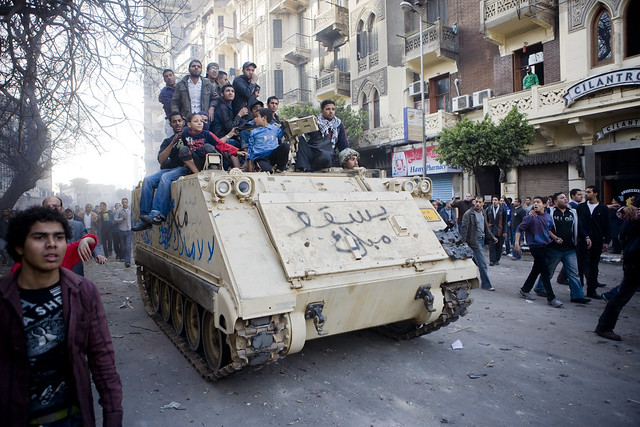
As i am talking to you there are more than 15,000 demonstrators in Tahrir square who are still occupying it. Earlier in the day the army came to evict the protestors by trying to destroy the barricades they set up near the Egyptian Museum and although the leader of the Muslim Brotherhood in the square Dr. Beltagui had ordered and called upon everybody via the microphone to not resist the army, people shouted back at him including the base cadres of the Al-Ikhw?n [Muslim Brotherhood] who were there. People ran and lay in front of the tanks in order to stop them which they managed to do. Later the army sent the commander of the central region, which is basically Cairo and the surrounding areas, along with three generals, to convince the protesters to leave but they shouted back at him saying “We’re not leaving until Mubarak leaves.”
It’s raining in Cairo now, it’s very cold but the protestors are holding out and more from the other provinces, specifically from Suez, have descended on Cairo to join the occupation today. In the meantime the government is continuing with its witch-hunt and demonization campaign against the protestors, blaming them for whatever malaise the country is going through at the moment which is actually the fault of the government and not the protestors. This follows twelve days of continuous protests starting on the 25th of January. The 25th of January is National Police Day here in Egypt and that’s when the protests actually started. The Egyptian government wanted to basically liberate the Liberation Square, Tahrir Square, from the protestors today. And they started that in the morning but they have failed. It has been announced that tomorrow the government will resume work and they have called on all civil servants to attend to their jobs and to go to their factories. They wanted to smash the occupation of Tahrir today. But as I’m talking to you that occupation continues.
What are some of the hurdles the protest movement is facing, are there divisions emerging while trying to find common ground?
Yesterday the square was completely packed with more than one million protestors and Alexandria witnessed similar protests as well as the other provinces. But there are definitely big problems that the protest movement is now facing. Which way is the way forward? Today it has been announced that Gamal Mubarak and Safwat El-Sherif, who is one of the most hated figures and was the secretary general of the National Democratic Party, will be removed from their positions and one of Gamal Mubarak’s associates, Dr. Hossam Badrawi was to take the secretary general position instead. There was also news that appeared on Al Arabiya, BBC and Al Jazeera that Hosni Mubarak had resigned as the president of the NDP, but of course not from his post as President. But now there is confusion because these reports have been denied, then confirmed again and then denied, so we are waiting to see.
It is true that virtually all the opposition groups, whether they are the traditional political parties or the youth groups, have taken part in the uprising but the protests still remain spontaneous. Which means on the one hand, the people always surprise you by their militancy from below that exceeds all expectation, but on the other hand, there is always confusion about what is the way forward and what the clear alternative is. This could pose the threat of this revolution being hijacked. At the moment we have many people claiming to represent the downtown occupation and some of them are even engaged in negations with the government. Some groups say they will not negotiate until Mubarak goes, some think that if Mubarak goes we can negotiate with Omar Suleiman [vice president appointed by Mubarak on January 29th, ex-director of the Egyptian General Intelligence Services and the CIA’s go-to-guy on rendition], others say both Mubarak and Omar Suleiman have to go.

Is there momentum towards protestors taking over the means of production and other institutions of Egyptian society?
On the ground, organizing mechanisms are evolving slowly. Protestors have set up security committees to watch the exits and entrances to the square and to defend it from attacks by Mubarak’s thugs. There are makeshift hospitals that have also been erected in the square to treat the injured form the clashes with the thugs.
Discussions continue in circles that the protestors have put together in order to try to reach some unified demands and people take the platform where there is a mic and address the protestors. Whatever resolutions that the people like they cheer and whatever they don’t like they boo. The uprising up until now contained elements from all Egyptian society, whether it is the urban poor, the working class, and even sons and daughters of the Egyptian elite could be seen in the protest. But as the revolution continues, some polarization has started to happen naturally. Between those who are tired, meaning the middle class and the upper middle class who are saying that we should stop now and try to reach some compromise with the government, and those who basically have nothing to loose and who have sacrificed a lot, like the urban poor and the working class.
The intervention of the working class in the movement is also another question mark, because definitely in some of the provinces where mass protests were organized they contained a majority of workers. But we still haven’t seen an independent movement by those workers. Except in very few cases. For example I received a report about a textile mill owned by a company called Ghazl Meit Ghamr in Daqahliya, which is a province in the Nile Delta. The workers there have kicked out the CEO, they have occupied the factory and are self-managing it. This type of action has also been repeated in a printing house south of Cairo called Dar El-Ta’awon. There as well the workers have kicked out the CEO and are self managing the company. There are two other cases in Suez, where the clashes were the worst with the security forces during the uprising. The death toll is very high in Suez, we don’t actually know the real death toll until now. In two factories there, the Suez Steel Mill and the Suez Fertilizer Factory, workers have declared an open-ended strike until the regime falls. Other than that we have not seen, at least to my knowledge, independent working class action.
The last thing i would like to note is that the so-called popular committees have been springing up in the neighborhoods here in Cairo and in the provinces. This happened following the collapse of our police force and their cowardly withdrawal in front of the people last Friday [January 28th]. The government started whipping up the security paranoia amongst the citizens in addition to sending plainclothes thugs who were affiliated with the security services, just as it happened in Tunisia, to attack public and private property and fire shots in the air. Citizens immediately stepped in and started forming these popular committees to protect their neighborhoods. They have set up checkpoints, they are armed with knives, swords, machetes and sticks and they are inspecting cars that are coming in and out. In some areas, such as the province of Sharqiya, the popular committees are more or less completely running the town, organizing the traffic etc. But in many cases they also work in coordination with the army.
The army has played an important role in the uprising in Egypt, even receiving support from the US. Can you explain the role of the army amidst the protests?
Our army as you probably know is the biggest army in the Arab world. It receives 1.3 billion dollars from the USA every year. The military institution has always been the ruling institution we have in Egypt, even if our President hasn’t put on the military uniform since 1952. Their intervention by descending on to the streets on the night of Friday, the 28th of January, was based upon the order from the chief of the army, who at the end of the day is Hosni Mubarak. When the army first appeared in the streets they were positively welcomed by the people since the police is hated much more than the army here in Egypt. One reason is that the army does not have much contact with the civilians on a daily basis, unlike the police of course. Since people were sick of the police and paranoid of the security situation they initially welcomed the army to the neighborhoods and also to the entrances and exits of Tahrir Square. However we all know that, number one, the army can’t be trusted and number two, that when you hear Obama and the US administration coming out strongly in favor of a power transition supervised by the Egyptian military you understand what their role is in keeping Egypt stable. Specifically making sure there isn’t a radical regime that could threaten the security of Israel, the security of the Suez Canal and the continuous flow of oil.
The US administration itself has probably made a fool of themselves for the zillionth time owing to their position vis-a-vis the Egyptian revolution. Initially when the protests started HIllary Clinton immediately announced that they were not worried whatsoever and that the Mubarak regime was stable. And Joe Biden went on air and refused to label Mubarak as a dictator. Why? Because Mubarak is a friend of United States and a friend of Israel. This shows you the hypocrisy of the Americans when it comes to their barometer of who is a democrat and who is not. And now when they have finally reached the conclusion that Hosni Mubarak was to be overthrown, they are working day and night in order to secure his removal as smoothly as possible.
Cross-national inspiration was crucial for the wave of uprisings that we are witnessing, has there been the emergence of networks of coordination across Arab nations that are continuing and can pose as a viable alternative to the political landscape we see today?
The domino effect was definitely evident after the uprising in Tunisia. When Ben Ali was overthrown this was very much positively received by Egyptians who could draw parallels between the Tunisian situation and the Egyptian situation. There were also several protests that had already broken out in solidarity with Tunisia. The main slogan chanted in Tahrir Square and around the country is “El-Sha’ab yourid isqat el-Nizam” . This was the same slogan chanted by the Tunisians, “The people want the government to fall.” It is true that in the days leading unto the uprising there was much discussions over the internet and Tunisian activists were transferring some of their experiences when it comes to confronting the police, such as activist kits you should have with you when you are facing the police. But we don’t have any concrete mechanisms for coordination yet. All we get are tweets and emails saying “solidarity”, “we like what you are doing”, “you are a source of inspiration” etc. But i’m afraid that there aren’t any governing or coordinating mechanisms between these two movements yet. How will this develop in the future no one knows but I am personally hoping that this will be the start of something bigger. Because already the domino effect is spreading. You’ve seen Yemen. They have had mass protests against their dictator, who had to come out promising not to run again in elections and not to groom his son for succession. There were similar protests in Jordan and the King was quick to intervene and dissolve the cabinet and bring in a new one. There was already a mini-uprising in Algeria even before Egypt, which was put down brutally by the usual force of the Algerian state. But they have also had to make concessions , they removed the emergency law and they lowered the prices of basic commodities. It is still to early to judge, the uprising here is only 12 days old, in Tunisia it took one month. We’ll see how it goes.
Hossam el-Hamalawy’s photography from the streets:
http://www.flickr.com/photos/elhamalawy/sets/72157625821089247/
http://www.flickr.com/photos/elhamalawy/sets/72157625947671262/
His Blog:
http://www.arabawy.org/blog/
His Twitter:
http://twitter.com/3arabawy
source: “We’re Not Leaving Until Mubarak Leaves” | http://www.occupiedlondon.org/cairo/?p=300


