Categories
Features

Interview with Brian Holmes: Steps Toward a Cultural Strategy

Michael Wilson: Earlier this year, you were a part of a group of artists, students, educators, writers and theorists who came together at The Public School in an attempt to understand the crisis and to formulate radical responses.  Were your recent pieces on this site conceived in light of that project?

Brian Holmes: Of course. The students’ movement in California and around the US is a real opening for radical politics. It raises basic questions about what society has become and where it is going. I am a long-term critic of neoliberalism, I am convinced that this form of capitalism is totally unsustainable and unlivable. Since, however, it is squarely installed in the realms of knowledge, culture and information — since it is cognitive capitalism — it seems there is no more strategic point for opposition than the universities. That doesn’t mean that every point of opposition is not important, just that this one could become crucial if enough people would raise the basic questions of value, what’s society good for, how am I participating, which consequences does that have on others, etc. Those kinds of questions form the basis of the practical philosophy that interests me. The work at the Public School is one expression of this practical philosophy that comes to grips with the currently existing forms of society and asks how do these social forms make us who we are? How could we transform ourselves and the world we share? As the economy tanks and the basic insanity of the current mode of development reveals itself in the social unconscious, I guess there may well be increasing chances to get involved in this kind of thing.

MW: You seemed to experience a lot of hope at the US Social Forum – conjuring up an atmosphere of something like visionary realism. Did you feel a new kind of energy there? Is there a continuity with the anti-globalization movement or is this something new?

BH: I think it’s totally continuous, but social movements are directly confronted with the times, they are the expression of people facing today’s problems on the ground. To that extent, whenever such movements are active they are new. Perhaps quite a large number of movements are more active now than in the preceding ten years, because the needs and opportunities are greater. I definitely felt a new kind of energy there because I have never been to such a thing in the US (I lived the last 20 years in Europe). I guess most everyone involved in radical politics is somewhat visionary — they see the possibility of a different society — so when you all meet it’s an assemblage or concatenation of visions, that’s pretty inspiring. What’s new to me is the resolve of the American activists to go on with a double program, which involves opposing one or several facets of society as it is, usually on the national or systemic level, while pursuing some already existing transformative process on the ground, at the community level. This doesn’t function in the same way as the diffuse “hope” around the Obama campaign. It’s both more pragmatic and more idealistic. I left the Social Forum feeling very respectful of peoples’ capacities to sustain their systemic resistance on their home territories.

MW: That seems to be key — sustaining resistance on home territories. If our home territories are education, research-based art, journalism and more academic systems analysis, how important is it to integrate our approaches? Through something as disciplined as a collective re-imagining of pedagogy or just by resisting the star/fashion systems of their various disciplines and working together?

BH: That’s a very precise question. Actually the answer demands such an articulation in practice, to see what it produces. In France I used to work with an association of graphic artists based in a city called Ivry, just outside Paris. That association involved journalists, sociologists and also a version of systems analysis called Marxism. Popular education was one of the main concerns of this group, which was called “Ne Pas Plier” (Do Not Bend). Most of the work was around unemployed people’s movements, immigrants’ rights, homelessness and the general theme of exclusion. It was a very strong experience, and we made some significant contributions to the counter-globalization movement. From my perspective there was a limit to the way the group articulated itself, in a kind of national-communist framework that had made a lot of sense for several generations but was now seeing its institutional base erode without being able to connect to anything emergent. So I ended up leaving, but I always had this desire for exactly the kind of articulation you are suggesting. The tendency for me has been to work out of a more active moment — artistic research, activist campaigns — rather than beginning with pedagogy. In the US there is a kind of implied neutrality to pedagogy which undoubtedly has its reasons for existing in a multicultural democracy, but which makes political articulation difficult. There are definitely kinds of knowledge that have value in and of themselves, but knowledge about society does not fall into that category, it has a purpose, it’s political. So there is a kind of intuitive progression whereby journalistic or artistic investigation of society leads both to activism and to the analysis of social systems, with all of that providing the material for an engaged educational practice that is in itself politically motivated (though not simply subordinated to any of the components that go into it). Whether you unfold that progression by a disciplined process or just by working together with some kind of healthy repulsion toward prevailing norms, is a question of taste, of inclinations, of opportunities, whatever. Working across the disciplines, without denying their particular capacities and expertise, is definitely what I find most promising.

MW: In Fault Lines & Subduction Zones, you say that “we missed the opportunity of the 2008 meltdown and failed to impose any re-evaluation of the basic tenets of neoliberalism.” Could you elaborate on this?

BH: Hmm, we just went through the biggest financial crisis since 1929 and there has been no revision of the major tenets of neoliberal economics as put into practice by public officials. The whole recovery effort, including the Keynesian stimulus packages, has been conceived as a way to return the economy to its finance-driven, just-in-time production of hyper-consumerism. The models incarnated by Goldman Sachs and Wal-Mart — lightening fast computerized trading for the few, massive importation of cheap Chinese products for the many — remain the ideal figures of this society. As soon as the credit-card bottoms out it doesn’t work anymore, and obviously people are not going to get jobs out of that economy, just read the headlines. What I found impressive was the almost total absence of any expertise to support an opposing vision. Of course there are opposing visions, notably around the idea that the whole pattern of energy usage in our society needs to be reformulated through the production of basic tools and infrastructure: better insulated living spaces, more efficient transportation networks, multiple and decentralized energy production through solar and wind methods, healthier food production with less industrial inputs and so forth. There is also a growing recognition that these transformations involve basic changes in values and desires, therefore, there is an imaginary side to it, a need to rework “the imaginary institution of society,” as Castoriadis would say. But no one is able to act on these perceptions. One reason is that a broad constituency perceives no need to act: huge sectors of society see no urgency in climate change, they have no cultural problems with big-box consumption, they’re nationalist and militarist and they want less taxation. But the other reason, closer to us, is that for the last thirty years all the experts educated in the neoliberal universities have been trained only to fine-tune and perfect the formulas of finance-driven growth, global supply chains, human capital etc. Which is more functional and therefore more deadly than atavistic nationalism. It will be interesting to see whether the continuing decay in our quality of life leads to the appearance of some new ideas on the political and administrative stages.

MW: In the same text, you call for a “powerful utopian vision … with a concrete grasp” and “a new kind of common sense.” What characterizes this common sense? Fundamental assumptions about possibilities beyond the present crisis? Or a ‘sense of the common’ that others have talked about?

BH: I’ll go with both of those. You know, the theme of “the common” put forth by the Italian autonomist Marxists has been echoed very powerfully in much wider social circles by the Nobel prize awarded to Elinor Ostrom for her work on the commons, that is, on the management or stewardship of collectively used resources like grazing grounds, forests, fisheries and so forth. That’s a big turnaround for a prize committee that has been promoting Milton Friedman’s disciples for so many years, all of whom subscribe to the “tragedy of the commons” thesis that makes the free market into the only effective way of managing scarce resources. What we have been proposing for many years in autonomist circles is that culture itself — including science and technology — is a commons of language, image, affect and ideas, that it grows in productivity and value through the sharing of inventions and that this offers a new basis for social wealth in the knowledge societies. You can find these ideas throughout Hardt and Negri’s work, and they were developed quite extensively in France by participants in the Multitudes journal. Behind that, Karl Polanyi’s book, The Great Transformation, has been a huge inspiration for me. However, when I referred to a “common sense” I wasn’t actually thinking about such subtle things, more about the need to regain a political program that many people can agree on and share broadly as first principles on which the rest depends. For those purposes, an insistence on the common or on common goods as a kind of productive antithesis to private ownership and profit is probably too abstract. Still there’s obviously an interest in pursuing fundamental philosophical work in that direction!

MW: You seem critical of eschatology, but it seems clear that you also believe that we are at the end of an age or at a time of profound transformation. Is this in response to what might be called a fetishizing of ‘the end’ on the left?

BH: Since the time of Marx, leftists have always believed that capitalism was about to end in some mega-crisis. That belief has been obsolete since the Thirties, when Keynesian social-democracy added a new wrinkle to the capitalist state and proved that even major economic crises can be managed. In the wake of the Great Depression, and also of the long-term recession of the 1970s and the subsequent rise of financially-driven globalization, what’s become evident to many social theorists is that the capitalist economy goes through technological, organizational, political and geographical changes in the course of each major crisis. So instead of focusing on “end times” we should look down the pipe and try to imagine what it might be like to come out on the other side. It may not look good, but it can’t be changed if you just deny it. People love the apocalyptic imaginary, but I am more interested in pathways through chaos.

MW: Is this a mirror of what we see on the right – an ‘end’-fetish/death drive channeled into fascist expressions?

BH: Everyone has their favorite psychological interpretation of Cheney, Palin, the Tea Party, Joe the Plumber and so on. But it’s easy to get lost in psychology. I just wanna say that a practical definition of fascism is when corporate elites seize on nationalist sentiment to carry out a program of police repression at home and militarism abroad, with state control over industrial production dictated and legitimated by those same urgencies. That sounds a lot like what we had from 2000 to 2008. I’d also maintain that the issue of state control over the banking and financial sectors is not the same as the militarization of the industrial economy. The latter is more closely associated with the right, and it’s built deeply into this society, Obama has done very little to change that. If there is a failure to get financialization under control and to achieve any transformation of consumerist desires, then a full-fledged war economy is likely to reappear as a pseudo-solution to the decline of American credit. That’s a present danger, given the dysfunctional nature of free-market thinking and the increasing likelihood that its Republican proponents will return to power. Industrial elites, nationalism and the militarization of the economy were the central facts of fascism back in the mid-twentieth century and their relevance to the present can’t be ignored. I do wonder about the denial of the ecological consequences of hyper-industrial society, the outburst of nationalist aggressivity, the underlying death-drive that suggests and so on. Max Blumenthal has written a fascinating but also somewhat simplistic book on James Dobson and Focus on the Family which takes the psychological road, check it out. I would be interested in going back to Wilhelm Reich’s The Mass Psychology of Fascism, which seems to be the founding text of leftist psychology, and exploring the long series of left-right conflicts that have knotted themselves around interpretations of childhood and sexuality. However I have not done the work and it’s probably a good class for The Public School.

MW: That’s an idea. Do you think work like Blumenthal’s is indicative of a liberal-left analysis in general – one that seeks to marginalize all radical challenges to neoliberal hegemony by labeling them ‘extremist’?

BH: Well, I’m sure the liberal left perceives me as an extremist! But even on the further left we are quick to toss our adversaries off as loonies. The thing about the neocons is that for a long time they have been playing a very canny game with the reactions to capitalist alienation that continually arise from their grassroots base. The neocon elites take those expressions of angst very seriously, then blow them up into nationalist, racist, anti-government rhetoric that they can use to win elections and impose their neoliberal program. On the left, we prefer to diagnose the Tea Party types and explain why they’re nuts, twisted, complexed or whatever. Blumenthal has some important psychological insights, but he follows this old leftist bent which is the easy way out, because it explains social problems rather than confronting social actors. At least Reich had a cultural strategy, he was suggesting the need for a different kind of childhood education, exactly the opposite of the disciplinary kind that Dobson recommends. Yet that still avoids the problem of making political arguments against people who have a well-defined stand on issues of national sovereignty, social cohesion, jobs and so on. The thing would be to use the Reichean psychological insights to understand how the nationalistic reactions are constituted, then find an analysis that reopens the connection between those reactions and their initial departure point, which in my view lies in the shock of continuous expropriation, deskilling, economic dislocation, financial predation and manipulative advertising culture. Up until recently the liberal left wasn’t really concerned about these things — they were able to get lucrative jobs out of informationalism and globalization, plus they enjoyed the mobility and the pleasures of hyper-consumerism. Now we have to offer our own answers to much more difficult questions.

MW:
Childhood education is a big part of this — authoritarian forms of organization on the level of education emerge directly from capitalist austerity, don’t they? Instead of talking about the de-funding of the public sector, we’re obsessed with discipline and standards-based achievement goals. This is what Dobson wants to produce from the start, but he certainly doesn’t stop there and neither should a movement that seeks to oppose fascism and/or capitalism. Dobson, and the right in general, consciously operate on many levels. But you seem to be asking for a way of understanding why someone would be mobilized by reactionary passions rather than liberatory ones and that leads one into the dynamics of resentment — precisely the thing capitalism produces more efficiently than anything else, even when it’s in freefall, no?

BH: You are right, an economic collapse can set off the dynamics of resentment, it’s been seen before. But the thing is to find the affective nexus where resentment and authoritarianism spring, and to offer some different resolution, a kind of constructive play — far away from standards and discipline. That was done with the counter-culture of the Sixties and Seventies, but in a utopian way that surfed on an economy of abundance. The utopianism was often libertarian in the broad sense of the term and so it got absorbed into the New Economy, it became the raw material of entrepreneurial innovation, what I call the flexible personality. In that regard, the Nineties marked a dead end in a cultural strategy of play. What has remained alive on the left and is re-emerging now is an ecological constructivism that seeks a positive response to the crisis.

MW: We seem to be collectively desiring some sort of cathartic rupture with the present – militant religious movements are one response, but the analysis you propose is a long way from rapture. How does the left reconcile that gap?

BH: I dunno, I try not to get apocalyptic. Then again, consider that the Book of Revelation was written during the decline of the Roman Empire. You are right that the contemporary sense of meaninglessness and disarray goes deep, and it may be that something more than just the American empire is ending. A full-fledged ecological crisis would ultimately entail a transformation of industrialism itself, a change of civilization. It’s obvious that the Old Left, a praxis philosophy for industrial civilization, has done nothing to overcome the gap you are talking about. Mike Davis goes around the planet of slums and finds only religious prophets. Surely it is more valuable to go to the Andean regions of South America and see how indigenist movements are transforming the leftist call for equality and redistribution. Those are materialist ecological struggles, of tremendous political importance. But I think when you come back, you still have to find out where the roots of social change can take hold here, and what they can blossom into. In the Sixties we started to understand that our frontier society was deeply imperialist, and that the difference between conquest and co-existence is profound. To make that discussion exist again in contemporary terms would be a beginning. To extend the discussion to include the problem of co-existence with our own intellectual faculties and tool-making capacities would be even better. We have to learn to live with the tremendous disruptive capacities of our own minds, it is a civilizational challenge.

MW: If an engaged, critical pedagogy is a way to mediate between activism and theory, how can we keep it vital? Paolo Friere emphasizes the need to work with those who are directly affected by what he calls the ‘thematic of domination’. Pedagogy is crucial to the revolutionary project for him, but it’s a dialogical, generative process facilitated by the ‘teacher/student’ from below — not a process of illumination executed by a vanguard elite. It seems like this form of ‘teaching’ is both more difficult and urgent than ever, considering the standards-based approach that’s infested the educational system in this country.

BH: You’re a working teacher, so you have a far better understanding of what’s possible in the classroom than I do. Particularly when it’s a matter of undoing the strange hierarchical relationship that has emerged between the precarious adjunct and the paying, loan-taking student. What interests me right now are co-educational processes that arise out of a desire to go on exploring ideas and interpreting information, long after the formal learning experience is over — or while it’s happening, for those students who don’t find what they’re seeking in the universities. I think this kind of experimental process could constitute a very different sort of vanguard, one that’s not based on an elite but instead on a radical difference in social relations. There are lots of people starting up such experiments right now and I just want to join them, to collaborate. If we — by which I mean the self-organized educational movement that’s now arising — can manage to develop situations that are intrinsically valuable, then maybe that will influence the wider culture. New ideas and new desires always have to be created by someone, sometime, somewhere. The current restructuring of the public university system is an invitation to look elsewhere, to investigate other possibilities.

Categories
Communiqués

On Not Allowing the Dead to Work, or Fight Firing with Firing

You are invited to join us for a conversation about getting fired, losing a job, and the implications and hidden potentialities of unemployment.

III: On Not Allowing the Dead to Work, or Fight Firing with Firing

A conversation about the cessation of labor moderated by Michael Wilson as part of an installation and event series by Liz Glynn

Saturday August 7, 2010

Beginning at 6pm; please arrive no later than 7pm

Located behind 2939 Johnston St., LA CA 90031 call 323 206 2433 if lost

Email liz_glynn (at) yahoo.com if you would like to attend future events in August and September

Categories
Features

FAULT LINES & SUBDUCTION ZONES: The Slow-Motion Crisis of Global Capital

The housing-price collapse of 2008, the credit crunch, the bank failures, the downswing of the world economy, the fiscal crisis of the sovereign states, all have been expressed as wild gyrations in the global circulation of information, attention, emotion. Everything undergoes tremendous acceleration at the crucial moments, before the wave recedes into a blur. We are sure that beneath the surface agitation, something has really changed. Institutions have been destroyed. The course of individual lives has dramatically shifted. The composition of the social classes has been altered in depth. For the first time since the 1970s, the continuity of the American way of development appears uncertain. Yet people find their surrounding environments exactly the same; while world leaders call for just one thing, a return to normal.

Amidst the paralysis of public debate, questions arise for those who can neither forget, nor clearly remember. How do we perceive social change? How do we grasp the facts that will prove decisive in the future? When will the surging wave return again? How do our own lives make a difference to the slow-motion crisis of global capital?

In his new book, The Enigma of Capital, David Harvey makes an important remark: the major crises of the capitalist system – like the Great Depression, the stagflation of the 1970s or the current deflation of the financialized economies – are never really “resolved.” Instead, the determinants of the crisis are shifted around to new places within the system, masking persistent instabilities and sowing the seeds of future upheavals. This means that the key components of the present social order – its technologies, organizational forms, labor relations, monetary instruments, its claims to rationality, security, justice etc. – all derive from the stopgap measures of the 1970s-80s, introduced to alleviate the last major downswing. But it also means that current chaos of the global markets will lead to further crucial shifts in the dynamics of social existence, with long-term outcomes that will inevitably be conditioned by the particular paths taken over the next decade or two. Such shifts in the compass of society do not only arise from decisions at the top. Instead they result from interactions between distinct and semi-autonomous “activity spheres,” of which Harvey names seven: “technologies and organizational forms; social relations; institutional and administrative arrangements; production and labor processes; relations to nature; the reproduction of daily life and of the species; and ‘mental conceptions of the world.’” Capital, for Harvey, plays the mediating role: “The relations between the spheres are not causal but dialectically interwoven through the circulation and accumulation of capital.”

Harvey’s work coincides in a number of ways with with the research program developed by Armin Medosch and myself, as a vehicle to investigate the dynamics of the crisis. Like him we are interested in the contradictions that can lead to the break-up of a more-or-less coherent phase of capital accumulation. That implies a concerted study of the phases themselves. One of our departure points is a chronological analysis of industrial development into “long waves” unfolding over roughly fifty-year spans, marked by successive phases of emergence, expansion, contraction and decline (or spring, summer, fall and winter phases). The long waves are themselves continually punctuated by shorter, sharper oscillations, generally known as business cycles, which occupy the newspaper headlines. Nonetheless, only these longer spans indicate the time frame within which something like a phase or a period can take form. The hypothesis of the long waves, launched by the statistical observations of Nikolai Kondratiev in the early 1920s, has been made more robust by the so-called “technological innovation school” which associates each wave with a group of major innovations around which economic growth is structured, thus giving rise to successive “ages”: the age of water-powered textile production; of steam and railways; of electricity and steel; of assembly line mass production (“Fordism”); and finally the present age of microelectronics and computer networks. Of course we’re aware that each of these five ages do not simply replace all that has gone before, as though starting each time from a clean slate. Instead they are layered onto each other one after the other, via the major periods of infrastructural development whereby the industrial societies seek to resolve the problems of excess capacity and shrinking markets, or what Harvey calls the “capital surplus absorption problem.”

Long waves of technological development provide us with a temporal framework in which to observe the development of crisis tendencies. Taking a further cue from the French “Regulation School” economists, we propose that the major phases of development should not be conceived in merely industrial or economic terms, but rather as “technopolitical paradigms” which embed each set of technologies and organizational forms within a cultural and institutional mix, while still allowing for the proactive role of specific political forces in the shaping of each period. Here we refer directly to the innovation-school theorist Carlota Perez, who points to at least some of the political and institutional factors that can help a long wave of technological development to consolidate itself and reach what she calls its “maturity phase”; but we also refer, as she does, to the constitution of scientific paradigms as studied by Thomas Kuhn. Finally, we draw on Giovanni Arrighi and the world systems theorists to understand the rise, expansion, decline and displacement of hegemonic centers in the geographical dynamics of capital. It is here that the images of “fault lines and subduction zones” – also referring to earlier research in the collaborative seminar “Continental Drift” – take on all their contemporary meaning. It should be stressed that all of these aspects feed directly into lived experience. By analyzing in detail the different facets that make up the current technopolitical paradigm, we hope to describe the texture and dynamics of the present period, to show how it emerged from the contradictions and decline of the previous one, and to identify in advance the weaknesses and bifurcations that will again throw the system into a prolonged period of chaos. The point is to seek a number of different pathways through this upcoming period of chaos.

Harvey enumerates seven “activity spheres” whose co-evolutions account for the crisis-prone dynamics of capitalism. We have adopted an analogous approach, which consists in a somewhat larger number of analytic categories into four broad fields: Productive Process, Integrative Processes, Global Protocols and Agents of Change. The first group includes the leading technologies of a given period, the energy sources that power them, the organizational forms that structure their production and the strategies of distribution and financing that bring them to market – in short, the most obviously “capitalist” aspects of the social order. The second group of analytic categories is derived from the Regulation School and from Karl Polanyi’s description of the ways that supposedly self-regulating markets are embedded in an institutional mix. These “Integrative Processes” include the wage relation between capital and labor and the forms of consumption and usage, as well as the core values and the legal and administrative devices that structure daily life; all of which mark the greatest subsisting areas of national, regional and ethnic divergence in an otherwise unifying world. The third group, “Global Protocols,” encompasses what Harvey in his new book refers to as the “state-finance nexus,” i.e. the international commercial and monetary order along with the border regimes and acts of sovereign military power that enforce such an order. Here, however, we also include what could be called an “epistemic regime,” which refers to scientific, legal and administrative norms and standards that have attained transnational validity at any given period, thus contributing to set the overarching parameters of a technopolitical paradigm. Finally, with the category “Agents of Change” we refer not only to the corporate and national innovation systems that drive technical change, but also to the subcultures, oppressed groups, entrepreneurial elites, revolutionary and mafia networks, and last but not least, the artistic and political vanguards that come to disrupt current forms of organization and introduce new inventions and values into the world.

graphic by Armin Medosch at The Next Layer

What we’re attempting is a synthesis of some major forms of social, economic and cultural analysis on the Left, in order to respond, during this moment of suspended crisis, to what Harvey calls “the enigma of capital.” The phrase is a strong one, and interestingly, it does not receive any explicit elaboration in the book. For my part, I’d formulate the riddle like this: How does the process of capital accumulation continue to make us who we are, despite its deep contradictions and recurrent breakdowns, and despite all the desires and efforts to overcome it and to steer society in some fundamentally different direction? No doubt it is on the eve of the great turning points, particularly those involving major wars and other disasters, when the juggernaut of capital accumulation appears most unstoppable and most deadly, that such an enigma takes on all its disturbing force. You may have noticed that the “activity sphere” which Harvey dubs “relations to nature” has no single place within our four broad fields of inquiry. This is because in the age of hyper-production, frenzied resource extraction and unchecked global warming, when ecological imbalances have arisen as a new central contradiction within capitalist accumulation, the relation to nature stands out as an essential factor within every field of human activity. The enigma of liberation is how we can cease to be what we always were, to find some other collective pathway for social development. Yet it would be naïve to think that capitalism is on the verge of some apocalyptic self-dissolution, or that a sixth technopolitical paradigm will not emerge after the decline of the present one. What we need is not eschatology (the science of final days) but instead, a strategic understanding of social complexity that can lend positive force to the diverse forms of human agency.

David Harvey ends his book with a chapter entitled “What is to be Done? And Who is Going to Do It?” Originally presented at the World Social Forum 2010 in Brazil under the title “Organizing for the Anti-Capitalist Transition,” the text examines the currently existing forces of resistance in order to formulate a “co-revolutionary” strategy of transformation operating across the dialectically interconnected spheres of capitalist society. Rather than maintaining or abandoning a working-class position, rather than taking up an anarchist, feminist, post-colonial, indigenista or progressive middle-class stance, he approaches contemporary society as a mosaic of repressive constraints and revolutionary possibilities, where each specific form of resistance or sectoral alternative is dependent on awareness of and active collaboration with the others. The Old Left notion of a vanguard party leading a single class at the cutting edge of capitalist development has totally disappeared, without any depreciation of the role of organized labor. What’s being broached here is an understanding of the potential for solidarity in multiplicity. The initial delivery of the talk at the Social Forum and its wide distribution on the net before the publication of the book express the desire of a great leftist intellectual to find new ways, not only of delivering a message, but above all, of opening up collective capacities of perception and expression. As though the prelude to any co-revolutionary strategy was a process of radical co-education.

This is what interests me today. How to knit together the disparate strands of resistance to the current mode of social development? How to regain a strategic mode of thinking on the Left? How to develop cultural forms which can support political engagement and activism through the expression of a sharable and enabling – rather than paralyzing – framework of understanding? These are obviously not questions which any one group can answer. What has been happening recently, and indeed, over the last decade and more, is a multiplication of experimental spaces of learning and action, in which aspects of the social/ecological question are brought into existential focus by people who have specific issues. Many activist campaigns have been developed whose importance should not be minimized, even in these dark days after the bank bailout and the rebooting of financially driven globalization, the failure of the climate summit in Copenhagen, the BP disaster in the Gulf of Mexico, etc. Yet despite important moments of convergence at local, national and transnational levels, clearly the coordinating capacities of the Left are radically insufficient when it comes to addressing the slow-motion crisis of global capital, and embracing the opportunities it offers. Is this not due to the absence of a philosophical and strategic horizon, where a powerful utopian vision combines with a concrete grasp of the many partial and sometimes internally contradictory steps that are needed to get anywhere? The point is not that we missed the opportunity of the 2008 meltdown and failed to impose any re-evaluation of the basic tenets of neoliberalism, because that’s water under the bridge, what’s done is done. Rather, the point is that much like the sudden melt of the Arctic ice in 2007, this last set of wild gyrations in the world economy signals the outset of a longer, slower crisis that will undoubtedly last for well over decade, before some new and perhaps extremely tenuous equilibrium is found. Now is the time to begin collaborating on a shared strategic framework – and really, on a new kind of common sense – that can help to coordinate the efforts of egalitarian ecological and social justice movements across a tumultuous period of systemic change that everyone will have to live through and face in the flesh.

Overarching goals don’t exclude specific acts. Over the course of the next year I will be participating in relatively small collaborative seminars in order to develop the ideas outlined here, and above all, to find clues for the elaboration of a radical pedagogy that is capable of putting abstract ideas to work in real contexts, with diverse groups of people. In a period when alternative and oppositional thinking is on the verge of being literally kicked out of public universities, the practice of collaborative pedagogy is itself a strategic concern. It is shocking and dismaying to realize – as we often had the opportunity to do over the last two years – that there presently exists no alternative school of economics, including the centrist Keynesians, that can effectively challenge the delirious and discredited dogma of neoliberalism, at least not in the USA. But an ecological-egalitarian science of social development will not spring full-blown from today’s free-market universities. It will need both an overwhelming desire from the public for something more humane, and a very clear and widely distributed consciousness of what actually exists, which is where the detailed analysis of our excessively complex society has its necessary place. By collaboratively examining the constitution of neoliberal society in all its different aspects, and by allowing oneself to feel its immense and unbearable power to make us what we are today, we might begin to find the inflection points where that social order is already breaking down and sliding irrevocably toward a new configuration. The important thing is to find ways of guiding, at least to some degree, the chaotic processes of change that are clearly coming.


* * * * *

— Next Seminar: Baltimore, August 7-8:

http://faultlines.redemmas.org

— Initial project texts:

http://brianholmes.wordpress.com/2009/10/25/four-pathways-through-chaos

http://thenextlayer.org/node/1211

–Previous seminar notes (first two pathways):

–A couple of background texts:

http://transform.eipcp.net/transversal/1106/holmes/en

http://brianholmes.wordpress.com/2009/11/06/is-it-written-in-the-stars

*

Categories
Features

COME ON, COGNITARIANS: One more effort if you want some equality

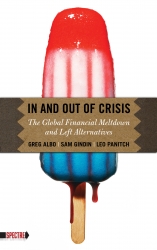
Free time? Out of work? Looking for a good summer read? Try the short, sharp, maybe even shocking book called In and Out of Crisis: The Global Financial Meltdown and Left Alternatives, by Greg Albo, Sam Gindin and Leo Panitch (available on aaaaarg.org). It goes straight to the sorry state of financially driven capitalism – which is the state we’re in (the USA).

The authors all live in Canada, but they focus on the US banking system. Their writing is concise and lucid, without the hasty diagnostics and predictions of decline that plague so many Marxists. Two ideas inform the discussion of recent events. The first is that despite incessant proclamations, the corporate makeover of American society since the age of Reagan has not involved deregulation and the downsizing of big government. Instead it’s been all about re-regulating the economic game in favor of the largest players, and shifting both tax revenues and borrowed funds to serve new priorities (such as bailing out the banks whenever there’s a crisis). The second key idea is that the astronomical sums of computerized finance are not simply “speculative” or “fictitious” capital, as critics on the conservative Right and radical Left often say. Instead they are directive forces, shaping global urban and industrial development through the allocation of credit, offering nearly irrresistible incentives for certain kinds of avaricious behavior and exerting powerful disciplinary effects on companies, local governments and individuals. What we face in today’s society is not just “speculation gone wild,” but an increasingly integrated system of management whose leading institutions, the investment banks, now appear to have been strengthened rather than weakened by the crisis. As the authors observe, “financialization gives rise to such financial volatility that crises actually become one of the developmental features of neoliberalism, and this reinforces rather than undermines the central position of financial interests in capitalist power structures.” The point is that despite radical dreams of one great big apocalyptic blowout, such a finely tuned system of national and planetary management is not going to disappear in an eyeblink. It can only be confronted and beaten back over the course of the upcoming years and decades, by social forces which are presently dormant or have yet to be developed.

Albo, Gindin and Panitch are basically unionists. They devote much of their effort to understanding how the egalitarian politics of organized labor has been neutralized by the enlistment of workers as unwilling participants in the competition between firms and nations. What results, under the threat of layoffs and joblessness, is a downward spiral of concessions that leaves workers individually poorer and collectively short on resources for the development of cultures of solidarity and progressive social transformation. Under these conditions, no one could blame the three authors if they focus on the needed changes in organized labor, which in their view would include moving beyond traditional collective bargaining, toward broad community campaigns that involve people outside a single sector or place of employment. There are a lot of good ideas in this book, and its lucidity inspires lots of respect for serious socialist organizers. Still I ended up feeling restless, particularly when reading that the sharp declines in union membership “reflect, in part, the difficulty of organizing the service sector, where about 80 percent of employment is now found.” After the recent GM bankruptcy, surely we need to look beyond the likes of the UAW? As a freelance writer and translator with academic degrees gathering dust on a wall, I feel much closer to that amorphous “service sector” than to assembly lines and shop stewards. For personal, economic and cultural reasons, my main man in this summer’s quest for class consciousness has not been a union organizer or even a direct actionist from a group like “Take Back the Land.” Instead it’s been a critic of the contemporary knowledge factories.

Life among the Lambs

Check out “The Structure and Silence of the Cognitariat,” an article by a UC Santa Barbara professor named Christopher Newfield. It’s a great piece, clear, concise and packed full of pertinent things you probably don’t know (find it in the edu-factory journal). The footnotes of Newfield’s text include some quotes in French that could be tough for les Americains. But hey, that allowed me to “apply” my dusty old Romance Languages degree, always a thrill. The text turns out to be a direct reply to concepts of class consciousness developed over the last decade in the French journal Multitudes, for which I used to write during another life in gay Paree.

Working with Antonio Negri, Maurizio Lazzarato and other Italian autonomists, we analyzed a basic contradiction at the heart of the knowledge society, or what we called “cognitive capitalism.” Namely, that knowledge is inherently abundant and proliferates under conditions of free circulation and cooperative development; while capitalism requires relative scarcity, absolutely private property and strict hierarchical control over producers. In an economy that’s increasingly based on communication, the application of science and the consumption of aesthetic goods and services, that contradiction is potentially very important. It often makes the knowledge worker feel that there’s something wrong with this picture. “Why do I keep getting controlled, when information wants to be free?” If that contradiction could be exacerbated, some of us thought during those heady days of the counter-globalization movements, then maybe we could launch a new kind of revolution. Cultural-intellectual sabotage, anyone?

Chris Newfield is more cautious, but in the end he’s working with a variation on the same ideas. Against the backdrop of the ongoing budget crisis of the University of California, he asks why knowledge societies like the US, Germany or France would chronically underfund their universities? Aren’t they the crucial institutions of cognitive capitalism, and maybe even of financially driven globalization? The seeming paradox is that while the old industrial corporations needed large numbers of college graduates to perform their management functions – a need most willingly fulfilled by the publics universities of the 50s and 60s – the New Economy flagships like Microsoft, with their pure brainpower products, have managed to severely restrict the numbers of salaried intellectual workers they employ, mainly by the use of temp contracts and outsourcing schemes. Similarly but more shockingly wheen you first find out about it, the universities themselves employ an average of 70% short-term contractuals and grad students to teach their undergraduate classes. If you want to see what direction the whole operation is headed, definitely watch the PBS Frontline reportage on “College, Inc.” which was still an eye-opener for me despite lots of reading on these subjects. There you see vocational business schools raking in big money for often fraudulent degrees. What you don’t hear a lot about anymore are real careers. Bizarrely, the number of good white collar jobs seems to be shrinking as the knowledge economy grows.

Newfield finds the solution to the paradox in the practices of knowledge management that began to be employed in the 1990s, at the time when massive numbers of kids who had grown up with the intellectual technologies of computers and the Internet just started coming on the job market. He quotes a suit named Thomas A. Stewart who makes a distinction between three different categories of knowledge. The first and lowest forms of knowledge are “commodity skills” like typing quick and talking nicely on the phone – skills which are easily obtained, add no value to the firm, require no particular concern for the employee and should be outsourced from the get-go. Next are “leveraged skills” requiring a lot of advanced education (my old standby of translation would be one, but computer programming is the classic example). These kinds of skills (“leveraged,” I suppose, by all the borrowing the owner did to acquire them) do add some value to the firm, but they can still can be codified, routinized, maybe even partially robotized, and rapidly gotten out of the way just like the others. What that leaves are “proprietary skills,” i.e. “the company-specific talents around which an organization builds a business.” These are the only kind that really matter, because they allow the firm to develop and own intellectual property, build a brand and cash in on some rare, secretly produced and closely guarded service. Now the hidden structure of the cognitariat leaps into view. The financial discipline of the firm requires it to make the distinction between the three types of knowledge, and to treat its employees accordingly. In the best of cases it can even practice “open innovation” which entails giving up entirely on in-house researchers or creatives and simply scanning the available knowledge resources, typically found in public universities, whose production can be creamed off at will for the price of a few small grants, maybe an endowed chair or a piece of fancy equipment. Under this scenario, the predatory strategy of the corporation is complete. Only the top researchers, managers and marketers will take home a real salary.

The new hierarchy of knowledge workers in the firm is bound up, in its turn, with much broader transformations. Christopher Newfield is also the author of an essential book entitled Unmaking the Public University: The Forty-Year Assault on the Middle Class (2008). Briefly put, his thesis is that with the expanded educational entitlements of the post-WWII period, the US began developing an enlarged, fully multicultural middle class that was potentially hegemonic and that began to transform society in its own diverse and complex image. In this new formation (which is described in a lot of cultural studies work) working class traditions and more recent immigrant cultures begin to fuse into a democratic hybrid, sustained by the models of success and the possibilities of self-invention that arose in the public universities. A new kind of language and even a new common sense emerge, dubbed “PC” by its critics and symbolized, in literary terms, by a complex artifact like I, Rigoberta Menchu, the oral history of a Guatemalan peasant activist as told to a metropolitan researcher with a microphone and a publishing contract. The conservative Right bitterly hated this kind of leftist talk-literature. But there was a little more to the opposition than a question of taste. What we called the “culture wars” of the late 80s and early 90s, says Newfield, was in fact the spearhead of a concerted attack by older elites against this new, radically democratic class formation – an attack that culminated with the dominance of neoliberal and then neoconservative ideology, the skyrocketing inequality of our own time and now the massive expropriation of middle- and working-class savings in the infamous “financial crisis.” The book repeats this fascinating thesis maybe once too often, but it is a goldmine of precise economic and sociological information for anyone interested in contemporary managerial techniques and the politics of education in the USA.

Working from this perspective, Newfield now suggests that we have a three-tiered university system. First come the top twenty private schools like Harvard and Yale, or the Ivy League Plus, that educates around 1% of the society. Next, “a group of about 150 colleges and universities that are ‘selective’ and have good reputations outside their local area.” And finally, some 3,500 institutions of sort-of higher learning for the hoi polloi, offering degrees with no particular value on the job market. At this point the scholarly author gets uncharacteristically angry, plays another very jarring French chord and claims that our society now resembles nothing so much as the Ancien Régime with its “Three Estates,” or stratified social standings. The First Estate, corresponding to the old aristocrats, is the top 0.1% of Americans who are essentially the bankers and financiers whose activities are described so well by Albo, Gindin and Panitch – the ruling class if you don’t mind me sayin’. The Second Estate, corresponding to the clergy of olden times, are the top 1% who earn over $350,000 a year. These are the upper votaries of capital and the state, who speak “technical languages of law, management and finance that are largely indecipherable even to highly educated non-specialists, and maintain an invisible empire of ownership structures and lucrative transactions whose existence makes itself known only through occasional disasters like the 2008 financial meltdown.” Mon Dieu! The Third Estate – le Peuple – are the rest of us, crammed into the vast category of the powerless and the silent despite the huge differences between the top 20% who are still “middle class” and all the rest who do not just worry over the “fear of falling,” but rather, get the experience of being pushed off the cliff and feel the indignity of not being able to pay their rent or their mortgage in the richest country in the world.

What I’m trying to get at is that the budgetary crisis and the conditions of precarious living that afflict knowledge workers are tightly entangled with and also sharply cut off from the directive actions of the financial elites who just robbed the country and strengthened their own positions in the process. What’s happening in the US is a sweeping and carefully concerted operation, not to resolve any of the major social and ecological problems that are staring us in the face, but to assure a strict separation of the classes. The divide is not into the traditional Three Estates that make for great satire, but instead into at least five groups: the aristocratic super-rich; the high priesthood of technocrats and traders; the merchant class who sell their soul to placate their fear of falling; everyone else on the roller coaster down to the bottom; and finally, the new immigrants who believe they can climb this weird human ladder (at least until they get to the state of Arizona).

So here’s another paradox: quite a large number of us in the third and fourth and fifth estates are well educated, we can speak all the languages we need. Tell me, what explains the silence of the lambs?

Starting Where You Are

Newfield doesn’t answer his own implicit question, except to say that in the advanced economies “the knowledge worker masses are still middle class on a world scale,” or in other words, they still have a long way to fall. Maybe, but an earthquake just happened and the cliff came a lot closer. What he criticizes in the theories of the Multitudes group is an excess of rosy optimism: the belief that an inherent contradiction of the knowledge economy would necessarily produce a revolt against its particularly well-constructed structure of injustice. Point well taken. With a fairly good grasp of the American scene I always felt exactly the same, and eventually I found myself on the political fault line that split the journal in two, right in the middle of the financial crisis in 2008. Yet like my autonomist friends and like Newfield, I still think some kind of mobilization of educated workers is necessary, desirable and maybe the most passionately inspiring thing you can do today, if starting from where you are means figuring out what to make of your scientific, technical, or cultural skills and your university education. Amid the bewildering complexity of the predatory knowledge economy, what’s missing is an active egalitarian and ecological critique of the owning and managing classes, a critique that does not remain locked away in the university but reaches out to the rest of society. That’s what we can build in the wake of the budgetary crisis, now that the new lines of inclusion and exclusion have been drawn and the writing on the wall is legible to practically everyone. The least you can say is that it’s getting urgent – after the lies of the Bush era, Katrina, the bailouts and the foreclosures, the Copenhagen debacle, the BP disaster that’s directly attributable to the pressures of neoliberal financial management, etc etc etc. The question is how to do it, when the traditional centers of education are so deeply instrumentalized?

According to Newfield we need a two-track strategy, the first of which should reveal “the hidden subsidies through which the Third Estate and its institutions support the other two – in many case, the ways by which public universities support private industry.” He warns that this first strategy may set off an internal civil war among the top faculty in research universities, which I guess is supposed to indicate how difficult this track will be to follow. The other strategy is “to re-imagine and articulate the broad social and cultural missions that will flow from the other nine-tenths of knowledge workers… whose ideas about diversity, equality, justice, technology for use, sustainable development and so many others are essential to the indirect modes through which knowledge and education create social value beyond that which economics can measure.” That sounds easier, to the extent that it can be done not only or maybe not even primarily inside the universities, but in self-organized seminars, affinity groups, clubs, artists’ collectives, cultural scenes, hacker labs and so forth, where the diverse languages of society mingle and knowledge circulates, hybridizes, throws off its old skins and moults into new colors. But this time, let’s try to find a path between the dark black cynical pessimism of typical American critics and that rosy Multitudes stuff I mentioned just before. Something more than a snap of the fingers is needed to delegitimate an extended technocracy that holds all the cards of power in its many active hands. If you look around, you’ll see that the sites of self-organized education and action in American society are very few, very fragmented, and far too often lacking in the subtle kind of creative focus that can at once rise to the level of the problems that face us, and not get co-opted into the very jargons and structures they seek to challenge. As the public universities are downsized (or really, expropriated) under the disciplinary pressure of the current budget crisis, an entire social process is waiting to be invented.

The US Social Forum, held in Detroit amid the ruins awaiting at the bottom, was sweet and delicious precisely because it was like a wide-open university, a laboratory upside-down, a radical experiment mixing very different people in order to find new ways of acting together. The combination of union organizers, community groups, radical intellectuals, artists, direct activists, social workers and many other sectors is fundamental to the politics we need on the Left, not just for strikes and protests but also when it comes to changing something within the key institutions of a rareified knowledge economy. Experiences like the Forum, or like a university occupation, can be a great inspiration for the deeper and slower work that starts from wherever you are, from your own class and cultural and economic position. Many groups are now trying out processes of invention, and we can encourage each other not by the sort of mutual denunciations that used to be the stock-in-trade of the extreme left, but instead by telling the stories of different attempts and by presenting the material, intellectual, social and artistic results. Of course there is a wider horizon to the singular experiments. At some point, by some combination of careful efforts, the dam has to break and larger numbers of people from all levels of society have to realize that something is wrong with this picture. Knowledge workers could help a lot by creating a clear language and a good set of images, to say what it is and to see it clearly. What we need to build are new and complex forms of pressure from below: social counter-forces to the disciplinary powers brought to bear by finance capitalism.

Creating those counter-forces is not going to be easy and it cannot be accomplished by any single group or tendency or philosophy. A very subtle form of political vocation has to find its original expressions on the tongues of the widely different sectors of society which are all under threat. Those whom we try to address in this webzine – the people who feel in some way interpellated by the current crisis of the university – are obviously just one group among others, as complex and fragmented as any other. The challenging thing is to give the fragments that we are some political coherency. But what else is there to do?

Come on, cognitarians. It’s going to be a wild ride. We’ve got some very interesting years ahead of us.

Opening march, US Social Forum, Detroit (photo Claire Pentecost)

Categories
Projects

EMPIRE STRIKES BACK: Organizing Inland

The Inland Empire has emerged as an epicenter for the relentless growth/crash dynamic of global capitalism – forcing workers out of jobs, families out of homes and students out of school. This massive displacement is the context for EMPIRE STRIKES BACK: Organizing Inland.

Just four years ago, you couldn’t find a better symbol of the economic boom than California’s Inland Empire—subdivisions, malls and warehouses were going up everywhere, filling in nearly every last empty spot on the map between LA and the desert. Today it’s hard to find a better symbol of what went wrong. Official unemployment is 15 percent, more than three times what it was in 2006. In the jobs that remain, wages are low and the future uncertain. State and local budgets are in tatters. Students are struggling to stay in school, while families wonder if they can keep their homes. And after a decade of explosive growth, the air quality is as bad as the foreclosure rate. But all over Southern California—from Boron to Fontana to Riverside—people are fighting back and organizing for a just and sane economy in the Inland Empire and beyond.

Part 1 – Neoliberal Appetites (March 3, 2010 at UC-Riverside) 


This event, led by Brian Holmes, focused on neoliberal subjectivity – the ways in which the present economic system both encourages and is encouraged by a set of fundamental assumptions, attitudes and perspectives.

Download the LECTURE (PDF)

Download the FACTS (PDF)

Download the POSTER (PDF)

Part 2 – Public Forum (April 6, 2010 at Universalist Unitarian Church of Riverside) 


Mike Davis, Victor Valle and representatives from seven organizations fighting for justice in the Inland Empire gathered in a public forum about what’s gone wrong and how we can join together to fight for a just and sustainable future.

Victor Valle (author of City of Industry: Genealogies of Power in Southern California) addresses the crowd at the Unitarian Church of Riverside on April 6, 2010.

“You are standing on valuable land…We have to have more occupations. We have to occupy the universities…We have to let ordinary people know what value is in their landscape.”

download mp3

The full text of Victor Valle’s address is available here

organized by Ben Ehrenreich, Ken Rogers & Michael Wilson