Categories
Communiqués

Carta abierta Re: OccupyLA—solidaridad, críticas, reinvenciones


Las personas fuertes no necesitan líderes fuertes.
Ella Baker

                                                        cual tantas cicatrices
como esto después del robo lo ‘desconocido’
viene ‘lo que una vez fue’ a formar sueños separados después de red de salvación peso se hunde finge que todo es inventado necesito decir finge que para todo nombre ellos nos lo han dado existe un gesto contrario para que nos colguemos [nosotros] caminamos dejando rastros tras la luz para ver

                                                         ‘tras la luz’
Craig Santos Perez

Les escribimos desde la Ocupación del Ayuntamiento de Los Ángeles. Primero y principal, en un mar torrencial y tempestuoso de resistencia, nos entusiasma y nos inspira que la gente en todo el país (y en todo el mundo) se esté reuniendo de manera abierta y flexible para ocupar los espacios públicos, para repensar lo posible. Es profundamente significativo que este proceso sin objetivos definidos haya dado inicio a un grupo de participantes radicalmente diversos—incluyendo a artistas como nosotr@s mism@s, que durante la semana pasada hemos participado en la ocupación desde las calles alrededor del Ayuntamiento, desde nuestras casas, en nuestros talleres y en nuestras salas de clase. Esto es de particular importancia en Los Ángeles—una ciudad diversa al máximo—donde el espacio público está sujeto a amenazas constantes de anulación y mercantilismo.

Escribimos desde la conciencia de las historias múltiples y experiencias actuales que están en juego en cualquier espacio “público”. Nos sentimos animad@s por las ocupaciones de los espacios que el Estado pretendería controlar—y mientras usamos los términos “ocupación” y “ocupar”, también somos crític@s frente a esos términos, al estar desplegados, por ejemplo, en los Territorios Ocupados o en la ocupación de Afganistán (en éste décimo aniversario de ese acto específico de terror imperialista) o al señalar la ocupación de las tierras indígenas que representan nuestras ciudades y sus infraestructuras. El reclamar palabras es complicado, turbio y problemático—y es precisamente por eso que es importante hablar entre lenguajes y subrayar los múltiples sentidos que están presentes en cualquier término o frase.

Estamos particularmente conscientes de qué tan significativo es que la gente se reúna para manifestar formas alternativas de organizarse. La gente está aprendiendo cómo cuidarse l@s un@s de l@s otr@s y cómo construir una infraestructura para mantener y hacer crecer el espacio poco manejable de la ocupación—o sea, el espacio poco manejable del mundo. Sin embargo, compartimos las inquietudes de mucha gente, en relación a que los modelos de organización estrictamente verticales y jerárquicos estén intentando imponer límites y controles en la espíritu y potencial de la ocupación. Reconocemos que tales jerarquías pueden ser invisibles y subtextuales; estamos conscientes de los retos de construir nuevos modos de relación y organización autónoma, y de qué tan profundamente arraigadas están las estructuras de poder y desigualdad—hasta la médula de la cultura. Compartimos la frustración y rencor expresados por muchas personas que no son anglo, muchas mujeres, y mucha gente que se identifica como queer o genderqueer, que el espacio de la ocupación a veces reproduce los sistemas de poder que están arraigados en nuestra sociedad, y por lo tanto en nuestro pensamiento. Esta no es una cuestión periférica. Más bien representa lo que es fundamentalmente problemático adentro de la ocupación tanto como un espacio poderoso de potencial para la transformación radical.

Nuestra capacidad para re-navegar los sistemas de exclusión y crear prácticas y estructuras de trabajo que reinventen los normas de poder, liderazgo y voluntad autónoma, es parte de la sustancia de nuestra revolución. El hecho de que un comité en contra de la brutalidad policiaca fuera sacado de la organización formal de OccupyLA indica las dinámicas de poder especialmente cargadas que están en juego en la estructura de la ocupación. Sin importar cuál fue la intención, es demasiado fácil entender esta exclusión como una reproducción de la ignorancia inherente a los sistemas sociales que no hacen caso a las inquietudes básica de la gente más afectada por un sistema vertical basado en el prejuicio, el miedo, o el pleno odio de la diferencia. Cuando pensemos en nuestra relación (o falta de tal) con la policía, no podemos evitar pensar en cómo la policía rutinariamente trata a la gente sin casa, cuya ocupación del espacio público no se lee como una resistencia, pero se podría entender como una síntoma de porqué es tan crucial resistir. El Departamento de Policía de Los Ángeles históricamente ha estado dentro de los departamentos de policía más corrompidos y militarizados en todo Estados Unidos. Para los que buscan justicia económica y social: ¡la policia no es tu amiga! (Si lo dudan, por favor hagan una búsqueda en internet de “José Bernal,” “Kelly Thomas,” “Settlement Mayday Macarthur Park,” o “Copwatch Los Angeles” para encontrar solamente unos cuantos ejemplos recientes.) ¿Cómo podemos organizarnos en simpatía, compasión y solidaridad mutua sin reproducir los sistemas enajenantes de administración?
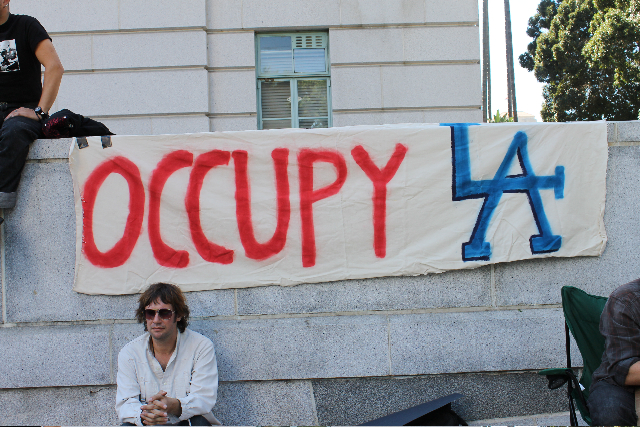
“Ocupación” también podría extenderse más allá del habitar 24/7 el espacio público por quienes reconocen nuestra marginación de un sistema económico y gubernamental basado en la absoluta ignorancia de nuestro ser como personas. Sí, los sitios de ocupación permanente en todo el país (más de 800 a partir de hoy, y siguen sumándose) necesitan sus presencias, sus energías, sus mentes creativas–¡solidarícense y déjense contar entre el 99%! Y sí, al mismo tiempo, nuestra visión de una ocupación puede abarcar múltiples sitios de resistencia y una reinvención de las prácticas de relación e intercambio. Pueden ocupar desde sus casas o desde sus oficinas o desde los camiones públicos o desde los asientos de sus bicicletas o desde la tienda de la esquina o desde sus escuelas o desde sus jardines comunitarios. Tenemos curiosidad y estamos interesados en toda manifestación de la reinvención revolucionaria de nuestros modos y nuestro momento, sin importar dónde ocurran. Y reconocemos nuestra afinidad con otras luchas que se manifiestan en otras partes. Nos solidarizamos con los huelguistas de hambre en la cárcel de Pelican Bay (round número dos). Nos solidarizamos con los que resistan el conducto de la escuela a la cárcel y sus manifestaciones más homicidas tras el linchamiento público de Troy Davis, patrocinado por el Estado. Nos solidarizamos con las trabajadoras domésticas que batallan por el reconocimiento de sus derechos básicos y con tod@s l@s trabajadores en la lucha por un sueldo digno y un trato decente. Nos solidarizamos con l@s que están sin documentos y sin temor, y con tod@s los que apoyen a los derechos de l@s migrantes de vivir y trabajar en paz (o sea, cualquiera que no sea indígena en este pedacito de las Américas). Nos solidarizamos con las muchas comunidades que batallan por la justicia económica y ambiental en el contexto de políticas y políticos que valoran las ganancias por encima de la gente una y otra vez. Estamos aquí para solidarizarnos. Estamos aquí para solidarizarnos con la capacidad de imaginar y manifestar una manera distinta de ser y con el compromiso de construir un mundo basado en la justicia, el respeto mutuo, la dignidad de toda vida, y el regocijo desenfrenado.

Entendemos la relevancia de las narrativas en los medios. Y aún así no aceptamos atender a las demandas de cualquier agenda reformista. A los que buscan una forma de capitalismo más amable y más gentil, como si un leve aumento en los impuestos de sociedades y la reforma financiera alterara la estructura de un sistema corrompido por el poder, hay que aclarar nuestras diferencias. Podemos coincidir en que el dinero corporativo ha corrompido nuestro sistema político. Criticamos de igual manera el hecho de que los que ganan el mayor 1% de los ingresos controlan más de la tercera parte del patrimonio neto del país. Muchos de nosotros no sentimos ninguna timidez en expresar nuestro odio hacia el mismo capitalismo, y las desigualdades institucionalizadas y arraigadas que se originen con él. No creemos que una resolución legislativa nos saque de esta crisis; el sistema legislativo en sí existe en el servicio de las estructuras del poder diseñadas para privilegiar los pocos a costa de los muchos, y basadas en una profunda falta de respeto hacia las necesidades y perspectivas de la mayoría de los seres humanos en este planeta (sin mencionar el planeta mismo). No nos entusiasma una resolución aprobada por el Consejo Municipal; hay que reinventar por completo las mismas estructuras del gobierno si éstas van a ser verdaderamente relevantes a las necesidades de la gente que pretendan apoyar (sin mencionar una visión de auto-gobernación autónoma). No recurrimos a las estructuras del poder existentes para, de alguna manera, resucitar algo que se haya roto; las estructuras del poder existentes son absolutamente inadecuadas para el mundo que habitamos (¡sin mencionar que no son absolutamente divertidas para experimentar!). No estamos protestando con la esperanza de que un estilo de vida imaginario se pueda restaurar en el futuro; estamos imaginando y manifestando una nueva manera de vivir aquí y ahora.

De igual manera estamos conscientes del tremendo carácter y complejidad de lo que representa reconocer todo esto. Y por eso estamos aquí todavía… En este espacio de posibilidad, con humildad y rabia y amor, esperamos empezar a construir un mundo donde efectivamente quisiéramos vivir. Hace falta más gente acá—en el espacio efervescente de la ocupación. Hace falta multiplicar las formas de participación en la ocupación para que junt@s podamos examinar las maneras que la misma ocupación pueda trabajar para socavar nuestro propio potencial para reproducir sistemas opresivos de administración y control. Ya está empezando a ocurrir—esta carta es solamente un ejemplo de varias críticas e instigaciones cariñosas y generativas. Hay que ser implacable e irreverentemente auto-crític@s. Ya corremos el riesgo de que la ocupación sea apropiada por fuerzas políticas y económicas que buscaran restaurar en vez de transformar la economía y nuestras maneras de convivir.

La vida.
La vida en su totalidad,
la vida con sus imperfecciones,
hospeda las estrellas vecinas
en ellas no hay tiempo …
y las nubes migrantes
en ellas no hay lugar.
Y la vida aquí
se pregunta:
¡Cómo la regresamos a la vida!
Mahmoud Darwish, traducción de Fady Joudah

Esperamos que otra gente escriba cartas abiertas. El objetivo de esta carta es participar en un diálogo crítico con una multiplicidad de voces—o sea, aproximarnos a y expandir el bullicio que ya existe. Esta carta es agradecidamente informada por muchos documentos textuales y visuales, incluyendo disoccupy, Racialicious, la Revista POOR y el Occupy Wall Street Journal. Tenemos ganas de escuchar, curiosidad de aprender, y entusiasmo para seguir encontrando maneras creativas de articular nuestro proceso de pensar.
No nos estamos uniendo a ningún movimiento; somos un movimiento y todo lo que hacemos—ya sea en el Ayuntamiento de Los Ángeles, en Freedom Plaza, en el supermercado o llevando a nuestr@s hij@s al parque—constituye un esfuerzo colectivo para reclamar el espacio popular común a través de repensar y reinventar radicalmente las relaciones entre l@s human@s y el mundo.

Con amor y solidaridad,
colectivo paracaidistas

P.D. Si quisieras responder o escribir una carta bajo el nombre del colectivo paracaidistas o si te gustaría recibir una versión en PDF de esta carta para cualquier propósito, por favor escríbenos al paracaidistascollective@gmail.com.


Categories
Communiqués

Only the beginning…

David Graeber’s piece in The Guardian on the Wall Street Occupation situates what is happening there in terms of the imagination. How refreshing to be reminded in stark terms not only how capitalism crushes so many imaginations but also the conceptual force of refusal.  It also appears that a network is developing as the occupation movement spreads across the country. What this movement means and where it is going remains to be seen but it seems clear that this is only the beginning of something.

Categories
Communiqués

Report: Mass Default

Recently, the spectre of mass default has been raised in a number of publications and forums.

From BayofRage.com, an online “anti-capitalist clearinghouse”, the Oakland Commune declares:

THE TIME HAS COME FOR MASS DEFAULT. Every debtor an Iceland! This is in some sense already happening as if by accident, as lives shudder under the unsustainable burden. It’s time for default as an organized, general strategy of self-defense and war on the owners of our present and future misery — a form of solidarity with strikes, sabotages, squats. It will require the organizing of communities to provide basic needs for the garnished, the liened, the excluded. This is both strategy and a renewed social order. This will be the practical meaning of a politics of friendship.

The website MassDefault.org offers a list of possible actions:

  • If you are a student, spend on your credit card and default.
  • Take out a bank loan and default.
  • Start or join a credit union.
  • Take out as much credit as you can, then when necessary declare bankruptcy (its not as bad as you think)
  • Form groups, stick together, this type of action in the world we live in can create isolation and anxiety. (Student food banks, markets, book swaps, car share, etc etc..)
  • Declare bankruptcy, if you are struggling try not to deceive yourself, its ok… its not shameful, these are tough times, don’t beat yourself up, you are actually doing some good!
  • Engage in direct action against mega banks.

In case the notion of choosing default seems like petit-bourgeois tantrum-throwing, there are those for whom default is the only option — and their numbers are rising.

From The Department of Education (September 12, 2011):

The U.S. Department of Education today released the official FY 2009 national student loan cohort default rate, which has risen to 8.8 percent, up from 7.0 percent in FY 2008. The cohort default rates increased for all sectors: from 6.0 percent to 7.2 percent for public institutions, from 4.0 percent to 4.6 percent for private institutions, and from 11.6 percent to 15 percent at for-profit schools.

Reclamations Journal has just produced an excellent resource for the coming default — a pamphlet called “Generation of Debt: The University in Default and the Undoing of Campus Life”.

Categories
Communiqués

A Note On The July 12 Protest Of The Summary Execution Of Charles Hill By Bay Area Rapid Transit Police On July 3, 2011

Thinking tonight about Muybridge’s Horse in Motion and yesterday’s BART protest, i can imagine the BART cars, stopped on the platform, like so many (of Muybridge’s) discrete, static cells, separating workers on their rush hour commute. Once set in motion, the cells and their content blur into one continuous image: the vision of seamless progress—

—the vision (here J Crary) “compatible with the smooth surface of a global marketplace with its unbound pathways of circulation and exchange.” No wonder a drunk, teetering near the tracks, a black man, or any protestor threatening to disrupt this flow are met with speeding bullets and riot cops:

BART police (and all the sycophants of capital we see bemoaning the inconvenience of being ‘stopped’ from their rush-hour trajet as docile subjects) are meant to annihilate the very objects that make the space in between these cells visible—they protect the spectacle, the illusion that there is no homelessness, no economic interest in racism, no alternative to work, servitude and exchange.

Text by Thea Pell

Categories
Communiqués

The Summary Execution of Kenneth Harding and Reaction to Police Terrorism in the San Francisco Bay Area: A Timeline

July 16, 2011: Police pursue and shoot Kenneth Harding for evading a fare on a public bus in the Bayview district of San Francisco

A cell phone video starting seconds after Harding was shot several times in the back:

Police use another video to bolster claims Harding was armed. yet the “handgun” appears to be a cellphone. Later, police will describe the figure in striped hoodie as wearing a black hoodie.

Harding dies at 7 PM on the evening of the 16th, amidst claims by police that he had a gun, even though none was found on the scene and despite multiple witnesses who said Harding was unarmed.

The shooting happened in the context of the Bay Area’s long history of police racism.  Kenneth Harding was an African American shot in the black neighborhood of Bayview .

From SF Bay View 

Another Black man – shot down in the street like a mad dog by occupation forces paid for by our tax dollars and 456 years of dehumanization – I read accounts of the incident and wonder: What is this young man’s name? Who are his people: family, friends etc.? Does he have a mother? Does she know her son is dead?

July 16-17 (overnight) Demonstrators respond to the murder, briefly occupying streets in Bayview  and the Mission.

From the So Stadium Status blog:

The angry, but mostly controlled crowd gathered near 16th and Valencia streets and walked through the Mission and Bayview around 1 a.m. Sunday morning. Police said there were reports of garbage being thrown into the street and several newspaper racks being overturned, but they made no arrests.

The demonstrations keep local Bay Area media focused on the shooting. KCBS quotes a woman saying “They’re rioting because people are pissed.” 

A flyer distributed at the protest declares war on the police: In reporting this we hope to make it obvious: we will no longer allow the police (regardless of what badge they wear) to murder us in the streets. When they kill, we will respond with force. These two marches along with the burgeoning revolt in Bayview are only a beginning. We do not care about their attempts at justifying themselves. In each of these killings they claim that their lives were in danger. We say they lie, but honestly don’t care either way. As the State has removed any illusion that it exists to serve or protect people, we can see clearly that it exists only to push us into prisons and to shoot us in cold blood. Two single dollars are worth more to them than our lives. The very existence of the police clearly endangers all of us, and we won’t be safe until they are destroyed.

Various groups report on the protest and connect the series of police murders in the Bay Area to the neoliberal economics of austerity

Meanwhile, the SFPD issues the following statement:

Information is still preliminary. The officers detained a 19 year old male suspect on the Muni light rail platform. This suspect then ran from the police officers who pursued him on foot. It appears that the suspect was armed with a gun and fired at the pursuing officers. At least one of the officers returned fire, in self defense, wounding the suspect. The suspect was transported to the hospital with life threatening injuries. He was pronounced deceased at 7:01 p.m.

July 17: Residents of Bayview  hold an impromptu speakout . Police pepper spray and attack participants. Meanwhile, activists organize a protest on the 19th.

July 18: Bayview  residents hold a second speakout 

July 19-20 (overnight): Activists protests in the Mission, near the Powell Street BART station.

(above) photos of action in the Mission July 19, 2011

Police with shotguns kettle activists, adopting a despicable strategy recently used by  London’s Metropolitan Police in recent protests over cuts to education.

Meanwhile police attempt to justify their action by releasing information about Harding’s past as a pimp and his conviction for attempting to promote prostitution involving a 14-year-old girl and stated that he was “a person of interest” in a shooting in washington state. The SFPD attempts to justify their actions on the basis of Hardings past, despite the fact that the cops involved knew nothing about it when they murdered him. Protestors responded to this specious argument in a leaflet distributed at the action:

The Police and the State consistently justify their systemic racist violence by saying they are protecting women. Patriarchy, the dominance of men over women, happens everywhere in our society, but the state tries to convince us that Black men are the main perpetrators. This racist lie helps the state justify their violent control over “uncontrollable” communities. Patriarchy is one of the overarching structures of our world and therefore we should not be surprised that any man has a past that includes violence against women. The police’s shooting of Harding is one instance of the way the state terrorizes a community that is a threat to the current social order, that has been historically attacked and barred from access to stable employment, etc… Its no longer politically correct to lynch Black men, but the police can shoot down Black and Brown people in the street and justify it through demonizing them.

The national media continue  to ignore the murder of Harding and it’s aftermath, but  bloggers in the Bay Area, such as Davey D, focus on it and the SFPD’s troubled history, pointing to the department’s recent dropping of more than 50 felony cases due to tainted evidence and insisting that the police account of the murder should not be taken at face value.

Local Bay Area media start to mildly question police inaction after Harding shot.

July 20th: Blogs associated with the national independent press start to cover Harding’s murder.

Bayview residents shout down San Francisco Police Chief Greg Suhr at a town hall meeting intended to justify the police’s action and calm the community.  The meeting serves to radicalize the consciousness of those in attendance. Many participants made statements such as:

We need to shut down the T line until we get answers to our demands – no police on trains, free trains or no trains at all. We’ll make sure there are no trains at all if that’s the way they want it.  

July 21: Police claim that the SF Medical examiner’s report shows that Harding shot himself while running away from police. The new SFPD account claims that they recovered a gun that matched the ballistics of the shooting and alleges other facts contradicting eyewitness accounts of Bayview  community members.

July 22: The Chief Medical Examiner of San Francisco states that she had not concluded that Harding shot himself. Suspicion and outrage grow among activists and Bayview community members. Some at rallies begin to ask if Harding was shot by a cop’s secondary weapon. Others call for a fare strike against MUNI and BART. Some invoke Chief Suhr’s dubious past to attack the limits of the SFPD’s credibility.

July 23: Activist Debray Carpenter A.K.A Fly Benzo arrested by 9 police officers “obviously in retaliation for organizing he has been doing” around Harding’s murder. “With this arrest, SFPD is attempting to fragment resistance to police terror & isolate the Bayview from collective action.” Call for action  his arraignment July 25 8:30 AM San Francisco Hall Of “Justice.”

The New York Times finally publishes a piece about Harding’s murder. The story assumes the police told the truth and frames SFPD Chief Suhr as the beleaguered hero of the story, among other bits of disinformation.

July 25: According to @mrdaveyd on Twitter®: Hardings family holds press conference with lawyers at the offices of John Buris, run down the police department’s shifting story, point out fallacies in official statements, the Buris law office formally requests  all SFPD evidence, family demand evidence be made  available to public, address Harding’s suposed criminal background and refute the claim Harding was “on the run.” Oscar Grant’s uncle and a dozen community leaders at press conference. Harding was enrolled in a Seattle community college. He was in the Bay Area to meet with a music manager. Harding’s brother owns a San Francisco record lable.   Witnesses have contacted Buris law office contradicting SFPD claims and stating Harding was left bleeding on the ground for 30 minutes. The nearest firehouse was 7 Blocks away, but paramedics did not come for 30 minutes. Witnesses establish a timeline.

Fly Benzo arraignment and action “tentatively” delayed until Thursday July 28th.

July 26: Charges dropped against Fly Benzo. Police repeatedly delay his release.

July 27: Early AM: Fly Benzo released after crowd at Hall of  “Justice” dissipates.

July 28: Press conference about DeBray Carpenter, AKA Fly Benzo, Noon. SF City Hall.

The people of the bay area will not accept serial summary executions by police. Further actions to come.