Categories
Communiqués

September Occupation Statement: UCSC

September 25, 2009 / 7:46 am

source: http://wewanteverything.wordpress.com/2009/09/25/occupation-statement/

We are occupying this building at the University of California, Santa Cruz, because the current situation has become untenable. Across the state, people are losing their jobs and getting evicted, while social services are slashed. California’s leaders from state officials to university presidents have demonstrated how they will deal with this crisis: everything and everyone is subordinated to the budget. They insulate themselves from the consequences of their own fiscal mismanagement, while those who can least afford it are left shouldering the burden. Every solution on offer only accelerates the decay of the State of California. It remains for the people to seize what is theirs.

The current attack on public education – under the guise of a fiscal emergency – is merely the culmination of a long-term trend. California’s regressive tax structure has undermined the 1960 Master Plan for free education. In this climate, the quality of K-12 education and the performance of its students have declined by every metric. Due to cuts to classes in Community Colleges, over 50,000 California youth have been turned away from the doors of higher education. California State University will reduce its enrollment by 40,000 students system wide for 2010-2011. We stand in solidarity with students across the state because the same things are happening to us. At the University of California, the administration will raise student fees to an unprecedented $10,300, a 32 percent increase in one year. Graduate students and lecturers return from summer vacation to find that their jobs have been cut; faculty and staff are forced to take furloughs. Entire departments are being gutted. Classes for undergraduates and graduates are harder to get into while students pay more. The university is being run like a corporation.

Let’s be frank: the promise of a financially secure life at the end of a university education is fast becoming an illusion. The jobs we are working toward will be no better than the jobs we already have to pay our way through school. Close to three-quarters of students work, many full-time. Even with these jobs, student loan volume rose 800 percent from 1977 to 2003. There is a direct connection between these deteriorating conditions and those impacting workers and families throughout California. Two million people are now unemployed across the state. 1.5 million more are underemployed out of a workforce of twenty million. As formerly secure, middle-class workers lose their homes to foreclosure, Depression-era shantytowns are cropping up across the state. The crisis is severe and widespread, yet the proposed solutions – the governor and state assembly organizing a bake sale to close the budget gap – are completely absurd.

We must face the fact that the time for pointless negotiations is over. Appeals to the UC administration and Sacramento are futile; instead, we appeal to each other, to the people with whom we are struggling, and not to those whom we struggle against. A single day of action at the university is not enough because we cannot afford to return to business as usual. We seek to form a unified movement with the people of California. Time and again, factional demands are turned against us by our leaders and used to divide social workers against teachers, nurses against students, librarians against park rangers, in a competition for resources they tell us are increasingly scarce. This crisis is general, and the revolt must be generalized. Escalation is absolutely necessary. We have no other option.

Occupation is a tactic for escalating struggles, a tactic recently used at the Chicago Windows and Doors factory and at the New School in New York City. It can happen throughout California too. As undergraduates, graduate students, faculty, and staff, we call on everyone at the UC to support this occupation by continuing the walkouts and strikes into tomorrow, the next day, and for the indefinite future. We call on the people of California to occupy and escalate.

Categories
Communiqués

Future of the Public School

A Class at The Public School (LA)

facilitated by Brian Holmes

The destiny of social movements is to change the structure of human relations — so be careful what you ask for! This class aims to look at the cultural roots of the current university crisis, and in that light, to explore the role that experiments like The Public School could play in re-imagining education. The class will be discussion based and can be expanded/completed/reoriented by other inputs. It will take place September 4-5.

Some deep reference points for the discussion are provided by the critical work by two UC professors, Christopher Newfield and Robert Samuels. Newfield develops an idealized historical figure of the public university as the cultural vehicle of an expanded, multi-ethnic middle class, and shows how its capacity to elaborate its own measures and values was strengthened by the social activism of the 1960s and 70s, before being eroded by the introduction of entrepreneurial conceptions of creativity and innovation in the 90s. He’s particularly good on identifying dominant business practices and showing how they came to overdetermine cultural values; to go further with that we could look into the work of management guru Peter Drucker on the knowledge economy, as well as Henry Chesbrough’s model of “open innovation.”

Samuels begins with the mediated experience of networked society and examines the ambiguous mix of autonomy and alienation characterizing the individualized, semi-automated environment of games, movies and social media (the expression of what he calls “automodernity”). He critiques a lot of “high theory” and develops his own take on the psychopathology of everyday experience in the digital age; plus he is far more critical of faculty self-interest than Newfield. Samuels is really asking how to create critical social movements under the social and psychic conditions of what I call “the flexible personality.”

Both these guys are active participants in the UC debate, and their arguments go a long way toward revealing what’s at stake, both culturally and economically, in the current transformation of public universities. We could read them from a very specific perspective, asking not only whether they get it right, but what relevance their portrayals of contemporary society and its institutions might have for people trying to invent their own self-managed processes of education. By assessing the state of society’s major institutions of higher learning we could ask which directions should be taken by vanguard experiments seeking a dialectical relation to the mainstream. In this way the class would feed back into the current campus movements while pointing toward further horizons.

Readings (to be completed by other proposals):

–Christopher Newfield, Unmaking the Public University: The Forty-Year Assault on the Middle Class, esp. chapters 1-3, 5 and 8.

–Robert Samuels, New Media, Cultural Studies and Critical Theory after Postmodernism: Automodernity from Zizek to Laclau, esp. chaps 1, 5, 6, 8 and 9.

Link to class at The Public School website

Categories
Communiqués

Loren Goldner in LA & SF

Los Angeles and San Francisco Bay INSANE DIALECTICAL POSSE present:

WORLD CAPITALIST CRISIS & PROSPECTS FOR A RADICAL RESPONSE

Los Angeles event:

Saturday, August 28, 2010 at 7:00 p.m.

Los Angeles Municipal Art Gallery at Barnsdall Park
4800 Hollywood Blvd, Los Angeles, CA 90027 (directions)

Presentation by Loren Goldner, to be followed by discussion:

That world capitalism is in a profound crisis is no secret, especially in hard-hit areas such as California. But a radical response requires an understanding of the deep, “epochal” causes of the crisis, beyond now-mainstream banter about financialization or sub-prime or Wall Street bailouts and bonuses. What has happened since 2008 is merely an acceleration of the “slow motion” crisis that has been with us in reality since the late 1960’s/early 1970’s. The crisis is global, and the response to it must ultimately be global.

Loren will give an overview of this decades-long crisis and its deepening in the past three years, and discuss what must be done to avoid the obvious capitalist “solutions” to it, which are much greater austerity and possibly a major war. He will talk about some attempts to organize against the crisis, such as in Greece or California or the recent strikes in China.

Quote:
Loren Goldner is a writer based in New York. He lived in South Korea from 2005 to 2009 working on a book on the Korean working class. He is an editor of the new on-line journal Insurgent Notes.

Much of his work is available on the Break Their Haughty Power web site

To have a more focused discussion, people attending might look at these recent articles by Goldner on the crisis:

Global Leveraged Buyout or the ‘Longest Boom in Capitalist History’

The Biggest October Surprise of All: A World Capitalist Collapse

Oakland event:

Tuesday, August 31, 2010, at 7:00 p.m.

Niebyl-Proctor Marxist Library
6501 Telegraph Avenue (at 65th Street), Oakland
(510) 595-7417

_____________________________________________________________________________________________

Monday, September 6 (Labor Day), 2010 at 6:00 p.m.

Loren Goldner will present on his book:

Herman Melville: Between Charlemagne and the Antemosaic Cosmic Man. Race, Class and the Crisis of Bourgeois Ideology in an American Renaissance Writer, (2006). ISBN 0-9700-308-2-7. 291 p.

In Europe, after 1848, bourgeois consciousness in revolt sought a new universal in the working class but soon found itself in the orbit of the state civil service; in America, bourgeois consciousness in revolt found a new universal in what Melville called “antemosaic” reality, Queequeg, embodied in the multiracial working class, the “anacharsis Cloots deputation,” in radical antithesis to the state. Through a series of scholarly, linked essays, Goldner examines the works of Melville, the dispossessed grand bourgeois, and his treatment of race and class. The 1848-1850 conjuncture in the Atlantic world witnessed the birth of communism (Marx), modern art (Courbet, Flaubert), the end of classical political economy, and the formulation of the entropy law, or Second Law of Thermodynamics. Their simultaneity was not accidental, and Melville’s work echoes each of them. Echoing the work of CLR James, this is a majestic, multidisciplinary sweep through history, culture, politics, philosophy and art.

Niebyl-Proctor Marxist Library
6501 Telegraph Avenue (at 65th Street), Oakland
(510) 595-7417

Categories
Communiqués

On Not Allowing the Dead to Work, or Fight Firing with Firing

You are invited to join us for a conversation about getting fired, losing a job, and the implications and hidden potentialities of unemployment.

III: On Not Allowing the Dead to Work, or Fight Firing with Firing

A conversation about the cessation of labor moderated by Michael Wilson as part of an installation and event series by Liz Glynn

Saturday August 7, 2010

Beginning at 6pm; please arrive no later than 7pm

Located behind 2939 Johnston St., LA CA 90031 call 323 206 2433 if lost

Email liz_glynn (at) yahoo.com if you would like to attend future events in August and September

Categories
Communiqués

Boggs, Wallerstein on Detroit, Movements, and Systems

by Frank Edwards |   Published June 24, 2010 at AreaChicago

USSF

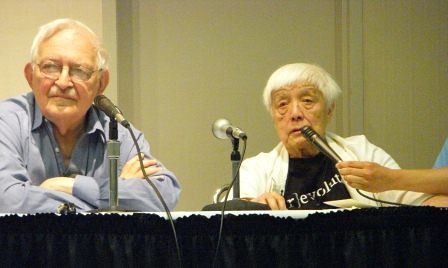
It was truly an honor to be witness to a conversation between Grace Lee Boggs and Immanuel Wallerstein this morning at the Social Forum.  I recorded audio (available for download here), and jotted down a few notes that I’d love to share.  I know I will listen to this conversation again soon, and hope to spend some more time when things are less hectic reflecting on their words and observations.

Boggs, wallerstein

Full article [here]